Categories
Gallery Watching

White Noise

My last two drawing days in the galleries and my nerves are still ever present. I want success too much, and yet I am aware that I don’t really know what I mean by that, other than a generation of energy and exhiliration that comes when I feel that I am drawing well. And again, what do I mean by well? Honestly, with integrity? Or just the joy of being lost in it, the state of none thinking. It is rare, I know this.

The wanting too much has made me a scaredy-cat today and I find a corner in Ruthin Craft Centre’s Gallery 3 exhibition Surface Matters to ‘hide’ in. I came with a vague notion of drawing these particular ceramics because I remembered their painterly-ness and freedom. But I can’t get them right and the corridor-like shape of the gallery is, as ever, a challenge.

And people don’t stay long in this space. I don’t know why. Perhaps it’s the constantly sliding open of the door behind me, the exposure to the outside by the window and the general lack of cosiness. Those that do stay tend to be afficiandos. They look, take photos, ponder, scratch heads, confer with companions, go away and then return.

This man comes in with a women, presumably his wife. She leaves but he lags behind, taking photos. Is he a buyer or a ceramicist? They don’t acknowledge me. I fuss over details, trying to get the colours right. The thrown shadows of the pots are best. I love how this project has encouraged me to really look at craft, and indeed, the curation of them. In this series, by Barry Stedman, the splashes and swathes of colour define the vessels, more so, it appears, than the forms do. I like them.

I’ve found with this project that I’ve been drawn more and more into focussing on capturing the spaces in which art is shown. I’m fascinated by the peripheral furniture, the plinths, the shelves, the seats, the cameras, fire-hoses and fire-exit signs. It’s more of a commitment though – harder, less spontaneous – (and I fuss and faddle over them trying to get them right), possibly because they are still. Whatever the reason, switching from this mindset to that of trying to capture the visitors is a tricky one. And I want to kick myself for my slow brain (I need more tea, clearly).

I watch this couple wander up and down the gallery. Eventually the man speaks to me. “Are you going to sit there all day?”

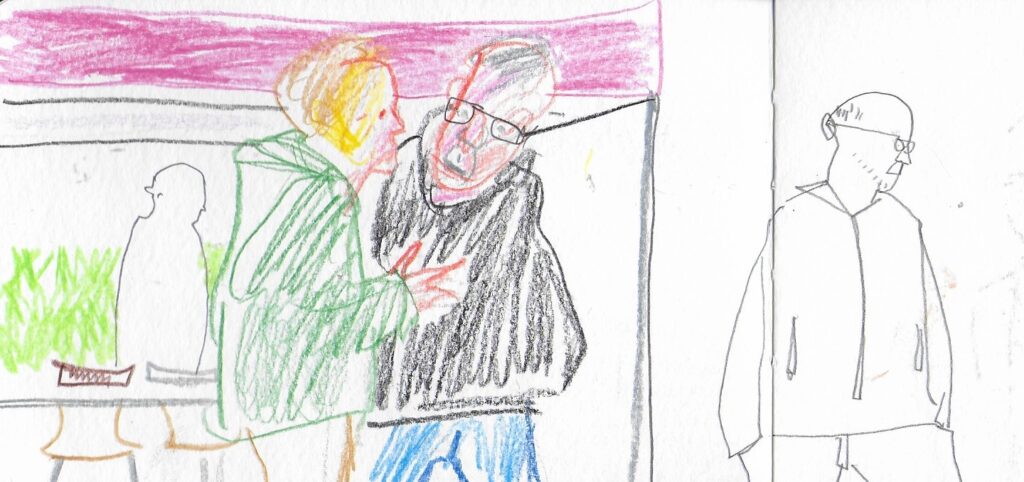
“Yes,” I reply, willing him to engage in a proper conversation with me so that I can draw them. He appears open to this and tells me that they are from The Potteries but when they retired moved to a town near Worthing. They collect ceramics and he mentions the Frith pots he saw on the way in. He came to buy but all the pieces he likes have been sold. His wife joins him and they talk about the North-South Divide, bemoaning what they see to be the unfriendliness of Southerners. “The weather’s better, though,” they say.

I tend to reach for my dip pen and ink when visitors walk in. It forces me to be succinct but it is a hit-and-miss activity, and in response to my painfully torpid efforts I want to throw it all down in a paddy. (I do have a little weep by the way, which helps. And I’m not very forthcoming when the Director comes over to say hello. I’m a bit of Grumpy Drawers. Sorry Philip).

The men make the best gestures – the ubquitious crossed arms, hunched shoulders, open mouths. What are they thinking?

There’s a seriousness to their contemplation. I like that. I’ve been researching the drawings of Honore Daumier and it’s evidently coming through here.

These series of vessels by Craig Underhill are closest to me so I have a go at trying to communicate their presence on the page. I love the scraffito marks – sometimes words – that have been scratched into the slip but their thrown shadows frustrate me.

As do my attempts at trying to express the line of vessels and their ‘conversations’ that follow the length of Gallery 3. I hint at the outside through the window but chicken-out at doing it with any boldness. It’s all about balance and trying to find a truth to it. But this is reportage after all. I can only tell my story of it.

I experience a slight frisson of irritation when visitors ‘interrupt’ the space. I feel that I’ve made it my remit to try and draw them as they come. This woman wears dungarees, and, like the others before her, gives the ceramics time. She takes photographs and looks and looks, her hand mostly going to her mouth.

Another serious viewer who does a lot of bending down, looking in close. Most don’t acknowledge me. Why should they? I’m disappointed with the day, though I can’t put my finger on why. Was it my tears, not being able to summon up energy, or my apparent unfriendliness? I cannot make sense of it.

My last drawing is of Underhill’s pot and the dead fly behind it. For all the jitters they have inspired, I shall miss these days. I relish coming to RCC. The work is always so carefully chosen and beautifully curated. It’s an oasis – calm, intelligent and uplifting. But I’ve still got my exhibition of sketchbooks to look forward to. I hope to see you there, in Studio 2 on September 30th. Oh, and thank you RCC for everything. It’s been marvellous.

My last drawing day at Oriel Davies too. And a new show to get used to. Helen Booth’s paintings were not what I expected, though to be honest I am not sure what that was. They make the Galleries calm, spacious and quiet. Mostly white tones with greys, yellows and pinks, none shout or clamour. Still tired from the day before I want to be undisturbed so I chicken out of Gallery 1 and opt for Gallery 2.

Finding a far corner I take my place, lay out my drawing materials and begin. I love the emptiness of the space. The lines of prints are so undemanding. It’s quite a space to take on as a drawing though and I have to keep up a inner encouragment not to give up. Again, I love the lights, the peripheral furniture and H&S equipment.

This row of drawings, of what look like black pebbles or maybe something biological, hang just above my head. I like the shadows they throw.

There are few visitors, which I am not unpleased about. I want to concentrate, to capture the space, the vacancy, the hollowness of the gallery. Those who do come in tend to be single women. Do I put them off? They don’t stay long.

At 12pm I go into the cafe for tea. Two women sit at separate tables. One reads a paper while the other waits for her soup.

I like treating the day as a constant drawing one. It’s become my way of responding, of interpreting the world around me. So much of it is about filtering, deciding all the time what is relevant, what tells the story and what can I catch before someone moves or leaves. There is a slight edge of panic which fires my adrenalin.

Drawing the spaces is a different challenge. I try to be true but there is always wonkiness, a misalignment. I have to remind myself that this is just an impression.

I like Booth’s unframed canvas – a whirlpool of interlaying circles smattered with splashes. And then there’s that gorgeous pillar-box red of the fire-hose.

I try to include the camera in the corner and the tripod seats that sit in a stand beneath.

The wavy bench is a real challenge to draw. It’s so stylish, like this Gallery which oozes it. And yet Oriel Davies is warm, open and generous too and not at all standoffish. I shall miss it and its staff. Thank you OD. And thank you Arts Council Wales for enabling all this to happen.

Before leaving I rush to catch the gesture of this young woman who, after seeing me, hides behind one of the screens to peek at the work. A work of moments. Did I get her?

Categories
Gallery Watching

Dentists, Angels and Footballers

It’s my penultimate drawing day at both galleries and even after almost a year I am still overtaken by nerves prior to starting. What is that about? I know it hampers me, making me self-conscious, stiff and clumsy in both thought and deed. It is almost as if an hour or maybe even two have to pass before my mind and hand coordinate and move in harmony. And I’m doing all this stumbling in public. Agh – why do I do this to myself? Yet even as I write it I know the answer – because sometimes, but only sometimes, something magical comes out of it and I draw in a way that is beyond me.

Ruthin Craft Centre has three new shows – two that are principally ceramics and one textile. I settle my bean bag against a wall and begin. I like trying to capture the text with the artworks as it adds context. I’ve begun to see the pivotal role letters and words play in this gallery and like it. The white walls invite them. And they are designed so elegantly.

The doors open and it’s immediately busy. I overhear conversations, mostly from what I take to be practising or amateur potters, commenting on the processes to each other.

The main show is all about texture. The big pots which I’ve placed myself behind are superb. I love their graffito-ed surfaces and, as I’ve come to find over the last ten months, I almost pray for an empty gallery so that I don’t feel obliged to draw the visitors but concentrate on capturing the work. The curation, as always, is sublime.

These are what I take to be a husband and wife. She does most of the talking, with him pitching in now and again. They do the circuit of the gallery several times. It’s nice to see them so engaged.

There’s a lovely interplay between Matthew Harris’ textile pieces in Gallery 2 and the Natural (Re)Source exhibit in Gallery 1. And there’s lots of reading matter that enables me to draw the readers in the ubquitious hand behind back posture.

And once again I am intrigued as to why it is that it is mostly men who adopt this stance. Is it about containing the extremities of the body? And is it just a Western thing?

Drawing these outlined, empty figures has become a feature of this project. I never intended to do them. But it seems to convey the passing of bodies across the artworks, often indistinct from each other.

Few people talk to me and the ones that do merely ask what I am doing and move on. I tell them about the exhibition next month and they all say they will come. Is it just politeness? A daughter and her elderly mother come in. The mother is deposited on the seat in the middle of the gallery after they’ve both agreed that walking around the space will be too much for her. The daughter sits next to her. They both survey the exhibition. “It’s very nice,” says the mother, her hat still firmly on her head though the sun has come out outside.

This man and his wife also walk around the ceramic exhibits several times, but with this couple he is the one who does the talking. They are evidently planning on purchasing something. “I think this is my second favourite,” he says to his wife, “though would I want it on my window-sill?”

Sometimes there is only time to make a quick line and they are gone.

I can’t work out whether this piece behind the stripped tree trunk is metallic or fibre. I like it and the man leaning almost in sympathy with the white tree is a treat to draw.

I’ve written on Instagram about women and their handbags in galleries, though I’ve seen it more in RCC than in Oriel Davies. Do they feel a little exposed in this space, out of their comfort zones, so to speak? And if that’s the case, is this the reason that these carriers of their known physical life and needs are clutched so tightly?

The owner of this miniature Schnauzer, who he tells me is called Primmy, is one of the few visitors who talk to me today. He holds Primmy still while I try to draw her but thankfully doesn’t ask to see it afterwards.

One of the women on the desk brings over an artist friend of hers to meet me. We talk while her little boy tries to get her attention. Eventually she leans down to him and he whispers something in her ear. “He wants me to tell you that he’s just been to the dentist,” she says.

I arrive at Oriel Davies knowing that there isn’t a show on. I planned to come anyway, saying that I’d draw in the cafe or outside. With the rain outside, the cafe it is.

It’s an impossible window to draw, and yet how can I ignore it since it dominates the space? I sit too comfortably on the sofa, uncertain where to start. I’m a little adrift. I thought I’d enjoy the lack of obvious focus but I don’t. There are no boundaries. I have too much freedom. Help. But draw I must, so I begin by simply following the lines.

It’s nice to see the cafe being used by the people of Newtown. I love this gallery, truly I do – it’s so deliciously egalitarian and unpompous. A woman comes in with two companions. She wears a leopard-print top. They are clearly having a meeting. Are they town councillors?

More drawings of the window. I’m too discombulated to opt for anything more than a pencil.

Another couple come in who appear to know the cafe barista/Manager quite well. Perhaps they are daily regulars.

Deborah pops in to tell me that there’s a work experience girl in the Education Room painting Welsh symbols (or is it flags?) to cut up for bunting and that she’s told her I might go in and draw her. The prospect is not a happy one but I go and have a look anyway. And then I see them.

The posters from a children’s workshop fill the walls, and they are marvellous. What a delight. I plonk myself on the floor and get my crayons out. The work experience girl and I chat and I make an attempt to draw her leaning over the trestle tables but it’s the children’s drawings that captivate me. Oh, to draw as they do… Deborah comes to ask the work experience girl to search for a particular image on Google and tells me that the kids’ workshop theme was Angels and Footballers, a response to the Verrocchio Angel show. “They’ve been up for ages,” she says, “haven’t you seen them before?” I probably have but being too focussed on drawing in the gallery I must’ve overlooked them. I’m sorry for that. They are as good as, if not more so, than many an exhibition I’ve visited – if, the excitation of joy is any measure of good-ness, that is.

I’m growing tired as I always do on these drawings days. I think it’s the anticipation of what they will ask of me that saps my energy. I make a last drawing of the rows of hooks on the Education Room wall, all set at child’s height. Lovely. As is the inclusion of the red fire hose. I’ve come to love gallery paraphernalia…. I shall miss these visits. I’ve learnt so much about art spaces, the relationships that visitors have with them and the art works they show. But mostly I’ve learnt about drawing and how sometimes I don’t want to do anything else. There’s no doubt that it’s become my lifetime’s work, my labour of love.

Categories
Gallery Watching

Thrown Shadows

I’ve loved the Ruthin Craft Centre shows over this last month or so. Their curation and use of space has been terrific. As has their diversity, with the energy and animation of Animal Rites set against the quiet intelligence of Jeanette Orrell’s Indigo Drawing and the elegiac stillness of Zoe Preece’s In Reverence.

In fact I made two visits to RCC in June – one to work with the Animal Rites for a second time and the other because Pete Telfer of Culture Colony was to film me there.

It’s hard enough drawing in public but having a camera trained on you while you are doing so makes it doubly difficult. Somehow I found an inner reserve of courage and bravura and just got on with it, camera or no camera.

Typically the gallery was quiet while the filming was taking place and Gareth from behind the desk had to be roped in as ‘pretend’ visitor. I liked drawing him, and he was stiller than most.

Jeanette Orrell’s drawing is gorgeous: it was a joy to transcribe their marks on paper using ink, crayon, chalk and wax.

Visitors passed like shadows across the painterly surfaces of her hanging textiles.

It fascinates me how each exhibition creates a different spatial narrative and mood. And how in turn the visitors respond to this.

I adore being given permission – as Indigo Drawing gave me – to make free-flowing inky and painterly gestures. And I appear to have developed a habit of making the viewers of these shows into predominantly ghostly outlines. It’s partly to do with the fact that they are moving – in some cases, quite fast – so there isn’t time to draw more than a silhouette. But it’s also about the dominance of (and indeed my interest in) the art on show.

I liked how the pattern on this man’s shirt reflected the organic shapes of Orrell’s work.

My last visit to RCC was to be all about Zoe Preece’s In Reverence. Each of the three galleries has their own ambience and personality. Gallery Two, with its lack of windows and natural light creating a sense of separateness, is darker – more sombre in a way – and colder. Sitting there in the corner on a bean bag it was the shadows that really spoke to me, creating a kind of grey negative space.

With strong resonances of Rachel Whiteread’s inner shapes of houses and objects, Preece’s whiteness – some in piles, and others lifted up and singled-out on shelves – was almost impossible to render.

Visitors mirrored its stillness and hushed restraint in their behaviour. Few people spoke. People peered in, holding their arms close to their bodies. “I long to touch,” said one woman.

The chairs and tables – surprising the whiteness with their warm browness – invited intimacy till one saw that they were exhibits and not for using. I didn’t read about the show’s intended meaning – I rarely do, finding statements tiring – preferring instead to form my own narrative. The domestic ordinariness of the objects, raised as they were to iconic stature, was glorious.

I found it hard to integrate the drawings of the visitors with those of the space. They were two different kinds of discipline – one quiet, almost studious, the other fast and scratchy.

What a lot of women clutching handbags there seemed to be.

Here’s another….

The first drawing I made. I fussed over it. It takes a while to warm up, to find my bravery.

And this one was my last. I was spent, drained. Everything had been packed away except for this one sketchbook and a pencil. She sat down to read the blurb. It was her pumps with their bows that caught my eye and then the contained way she folded her arm across her stomach as she read. Her mien encapsulated the exhibition for me. Reverent? Most certainly.

I was nervous about engaging with Oriel Davies’ new show, the Disability Arts Cymru Prize. It can be tricky to find a focus in a mixed show with no real overarching theme. And, to be honest I find it hard to draw wall-after-wall of small framed 2D artworks.

I was pleasantly surprised. The work was diverse and rich. “Heart-warming,” one visitor said.

But, as with Zoe Preece’s show at RCC, OD’s space dominated my drawings. There was no way round it. The gallery space described and delinated the exhibition – told its story, so to speak. And for me, the chairs set out for visitors along with the labels, the cameras, fire-exit signs and those ‘Borrower-like’ like doors in the panels with their tiny keyholes were all part and parcel of the visual experience.

The flow of bodies visiting the show was a irregular one. And the ones that came moved through the space rapidly.

As with my drawing at RCC, I became so involved with drawing the art and the spaces that contained it that trying to capture the visitors became almost secondary.

I rushed to make a drawing of this man however, as he grabbed one of the gallery chairs so that he could sit and compose a text. It was a long-winded affair with every letter being considered and slowly, painstakingly, typed in.

And then a familiar face turned up. He didn’t recognise me though we’d met twice before and had had long chats. “What are you doing?” he asked. When I explained, he remembered. “Ah,” he said, “I said a bientot last time, didn’t I?”

To iterate, the visitors to the gallery mostly whizzed around the exhibits. These two women however, took their time. The film showing in the semi-boxed in room behind where I was sitting was of particular interest.

A small girl and her mother came in. The girl was carrying a huge toy dog under her arm.

Prior to that an elderly woman had raced in and raced out again wearing full PPE, including a face guard. A large Co-op swung from her arm.

I drew this man in the cafe during a short break. Drawing becomes compulsive, particularly on one of my gallery days. I see things differently afterwards, everything is heightened.

These monthly endeavours are always more rewarding than I envisage, and the nervous energy they expend on them is worth it. Am I getting better? I don’t know. Each time I start I feel like I am back to square one. But I suppose that is the nature of practice, any practice. Till next time then.

Categories
Gallery Watching

The Hare & the Studio

I’d decided the month before that I would spend another day drawing Ruthin Craft Centre’s Animal Rites exhibit. I wobbled a bit over my decision – after all I’d had such an energetic and, to be frank, enjoyable time drawing the ceramic creatures at my last visit that I worried that I would be tempting fate to try and reenact it. Reminding myself over and over that it was up to me and that there was no right or wrong way of approaching drawing, I laid my things out at the opposite end of Gallery 3 and began to look. Just before I began drawing the textile artist Nigel Hurlstone popped his head round the corner. I haven’t actually met him but we’d spoken on the phone when I’d interviewed him for a feature with Embroidery magazine. He was as delightful in the flesh as he was over the phone. Just before he left me he shared an anecdote about when he was a student in Manchester. He’d gone to draw in the Cathedral, in the Remembrance Chapel. The person in charge said that that was fine, but strictly ‘no wet media’. Oh, that’s Ok, Nigel had replied, saying that he only used a little emulsion on the page as a base. After the man had gone, he then proceeded to knock over the bottle of paint all over the floor. “I spent the whole day trying to clean up the white. I think it’s still there to this day.”

Susan O’Byrne’s hare captivated me – how could it not, it is sublime. Becoming more sanguine about whether there are visitors to draw or not, I’ve got used to giving myself over to the artworks – so much so that sometimes when people come into the galleries I’m not in the right mindset to capture them. The hare, the birds (is that a hoopoe?) and the view through the window absorbed my attention so completely that the quick pencil rendition of the woman looking at them was rather ill-considered.

I love the curation of this show: the animals appear to converse and delicious narratives unfold.

With the sun out visitors were initially thin on the ground. (Though sitting by the constantly opening door, I froze; at one point my teeth were chattering – that’s reportage drawing for you.) And those that came didn’t stay long in Gallery 3; I didn’t mind but I was bemused – couldn’t they see the ceramicists’ skill? Most who came were of a certain generation and generally consisted of small groups of women, friends, mothers & daughters with only a scattering of men. I overheard one woman saying to her companion, pointing at each animal as she did, “I’d display that but not that,” adding, “the crows, I just couldn’t live with.”

I’ve written before about the challenge of setting the context of Gallery 3 within my drawings: there’s so much going on outside, and because the windows dominate, not only dividing up the space but providing it with sharply defined floods of light, the view of the outside pergolas and benches cannot really be ignored. But, as with all drawings, it’s about what to include and what to leave out. Having to work fast, I often make the wrong decisions (though didn’t I just say that there’s no such thing as wrong in drawing?) but try to keep going regardless, following Paul Hogarth’s rule of leaving the judgement till another day.

As an antidote to my slowness of reaction to the bodies that floated through the gallery in front of me, I mostly drew them with dip pen and ink. Few people stopped to talk to me, except for one woman who showed genuine interest in the pot with sponge that I use to clean my dip pens. She explained that she used to be an art teacher. Clearly still drawing, she pointed to all my paraphernalia strewn across the floor and smiled, “I’m always told off for spreading all my things out like that.”

Sometimes I reached for a pencil or a small brush to make a line wash. At this point a woman in a red gingham dress came in with another equally neatly dressed woman who appeared to be her mother. Perhaps they didn’t see me there in the corner; either way, the one who seemed to be her mother broke wind rather loudly. Both women giggled and moved on.

Ah, the hare again….there’s never time to do these marvellous beings justice and I must spend my next visit with Jeanette Orrell’s Indigo Drawings and then there’s Zoe Preece’s whiteness to explore…..how I love this gallery.

All too often the plans I have in my head as to what to focus on and where to sit go awry. I’d gone to Oriel Davies intent on drawing the Lithography show but when I got there it just seemed too formal, too squared and too rectangular. Having been told by Deborah at the desk that they’d decided to keep Nicky Ascott’s temporary studio up in Gallery 2, I wandered in there. There was a lot to take in. Another wobble until I saw the typewriter that had been placed on a little cupboard with the words (in pink) “Please use this typewriter to make your comments” (or something like it). It was enough. Having procured a bean bag, I set up my stall in the corner and began to draw it.

With the sun keeping most people outside, I was left to my own devices for much of the day. As I’ve come to find with this project, being forced to sit and look and capture the art work before me has taught me to engage with it on a deeper level. I begin to know it, even like it, by drawing it.

The bits of furniture that Ascott had dotted around the room were a wonderful counterpoint to the very painterly drawings and canvases either hanging or leaning against the wall.

Alas, I fear that, as with RCC the day before, portraying the visitors became of secondary concern. And there were so few. Most, not being prepared to give its eclectic-ness time to sink in opted for the safer ground of the Lithography show in the main gallery.

Giving myself over completely to Ascott’s fascinating reference wall, I drew each little note, postcard, object, fetish and book – even trying to relay the hand-written scrawls that define her paintings.

I’m amazed at how much I’m learning from facing the challenge of not only reportage-drawing visitors to the galleries but encapsulating the art spaces too. I feel so blessed by the opportunity to develop my drawing practice that this project has afforded me. Thank you RCC, OD and ACW.

(Photographs: Pip Jones)

Categories
Gallery Watching

Bulls, Crows & Llamas

Oh, why am I still a bag of nerves when I turn up to the galleries to draw? A little adrenalin is a good thing, but this anxiety that hollows out my stomach and makes me scratchy and edgy, is not. I try to contain it and be as well-mannered as I can, but those first ten, fifteen minutes or so between arriving, finding a place to sit and starting to draw are excruciating. Merely scanning the other two galleries, I knew, almost from the start, that I wanted to sit among RCC’s Animal Rites exhibition in Gallery 3. And what a joy it was!

At the start of this project I used to fret if there were no visitors. I am more sanguine now (see what I’ve learnt!) and, if nothing else is going on, I draw the art and the spaces and wait. Someone always comes. Liz Ellis’s crows and magpies – rendered gorgeously sinister by their blue-black brittle ceramic plumage – balanced on perches and metal hoops appear to climb the wall. I drew them over and over, too close to do them justice. But using ink, heavy graphite and thick pencil was, nevertheless, a good loosening-up process.

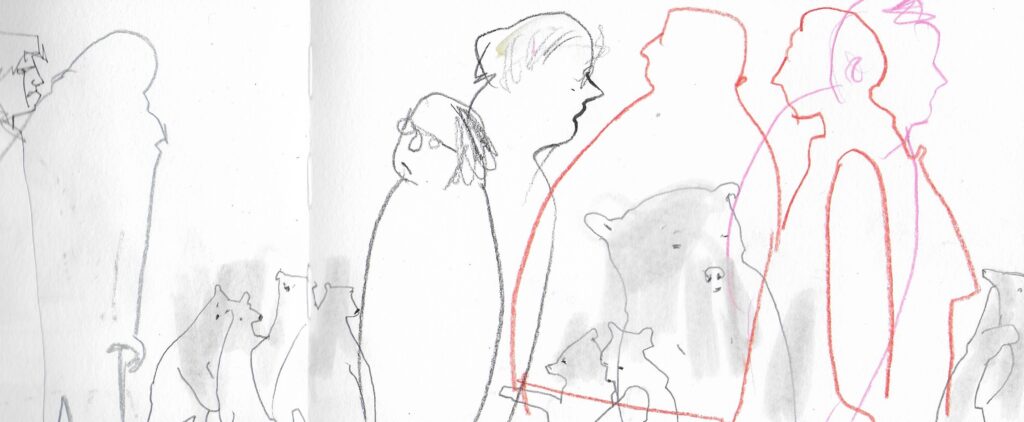
In direct contrast, Zoe Whiteside’s softness of polar bears called for white spaces and simple, contained lines. I could feel myself warming, relaxing and even enjoying myself. Hurrah.

But I was still not quite getting the crows. I needed to be further away and work larger but I want to contain the drawings in the sketchbooks – perhaps next time I could attach a kind of concertina page? I love the paraphernalia of the gallery spaces, such as the sockets, juxtaposed against the expressive freedom of the animal forms. As I sat and drew I fantasised about taking some of these fantastic creatures home.

Though it was quiet, visitors did come and go. Perhaps it was the late April sun outside. I could see people through the window sitting on the benches having coffee. It’s such a gentle place. Why was I so scared?

Ah, how I adore Brendan Hesmonhalgh’s bulls. I have a vague memory of seeing him demonstrating at the 2019 ICF in Aberystwyth. I couldn’t do justice to the painterly-ness of them, those touches of blue, of pink and the way the head of the larger one leans to one side, with a not-to-be-believed promise of benignity.

More crows in smudgey black.

People lean in, hands dug firmly into their pockets, as if controlling the desire to touch. I didn’t have many conversations today. I felt a little guilty. I was too absorbed, having too much fun. The few that I had included a woman who told me of her drawing practice and then asked if she could look at my books. Having done so and she then asked whether there was to be an exhibition. Another woman glanced down at a couple of books that I’d left on the floor. “Are they in your way?” I asked. She shook her head and muttered the word, “impressive” under her breath. Later a man on his way through to Gallery 2 stopped to look at what I was doing. “Is that a pencil that you’re using?” he asked. Yes, I said. “It’s a very thin line,” he said.

A visual amalgam of wheeled Victorian toys, archaic drawings of imagined animals and illustrations from Aesop’s Fables, Louise Bell’s collection of creatures delighted me. I want each and everyone of them and drew them with real pleasure.

Responding to the lack of constraint required in capturing these whimsical beings, I jumped up from my seat and stood or sat on the edge of the low plinth (sorry RCC) with my grabbed collection of pencils, crayons and oil pastels scattered on the floor.

Keeping several drawings going at once, I added a layering of human bodies over or behind Whiteside’s ‘lovingness’ of bears.

Freed-up by an energy borne out of using such an array of materials and the unpreciousness of my mark-making, I stopped trying to be so literal in describing the gallery space, allowing Whiteside’s penguins and Hesmondhalgh’s bulls and Jack Durling’s rhino to float around, encircling and challenging their lookers-on from all sides.

Spent, and packing up to leave, the ‘Lost in Art‘ group started amassing at the other end of the the gallery. As the huddle of people approached me, a one-legged man in a wheelchair looked at one of the ceramic animals and then looked at me, “That’s not you, is it?” he asked. I made a quick drawing of him but by then my self-consciousness had returned, and the marks were tentative. Made wary and hamstrung over the issue of consent and feeling that I might be somehow stealing something from him, I was hobbled. Sensitivity had punctured me – it was time to go home. Oh, but what a day.

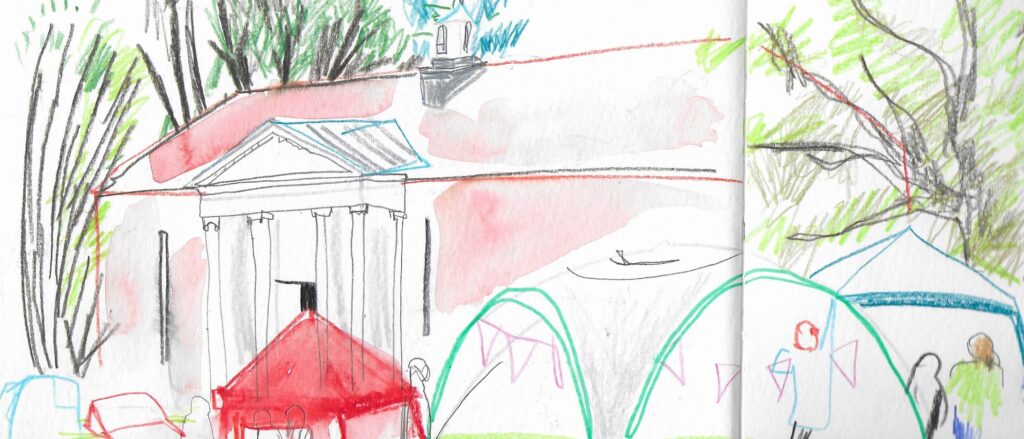
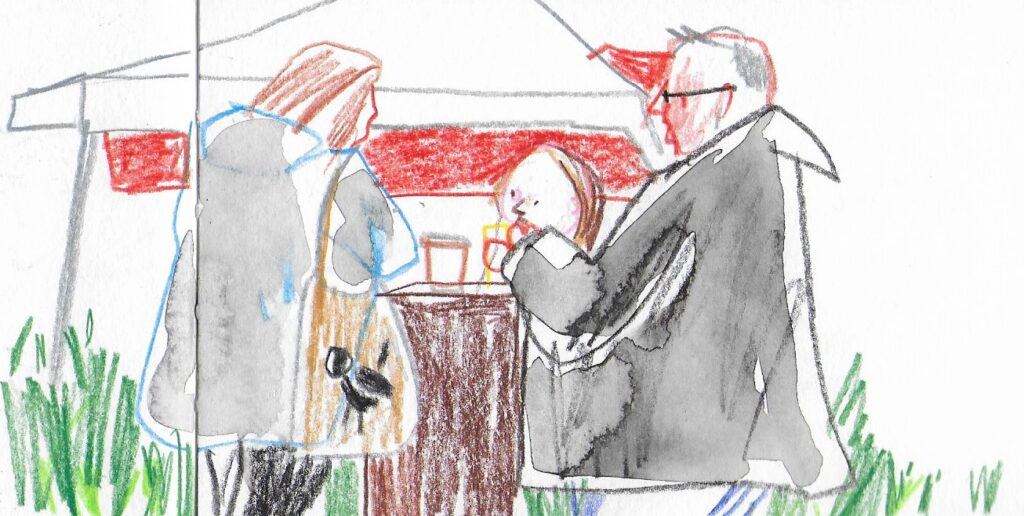
If I was anxious about drawing in RCC, I was doubly so about my day at Oriel Davies. With the Gallery closed to exhibitions, I’d suggested that I might come and draw at their Spring Fayre. As with all these things, it had seemed like a good idea at the time – lots of colour, tents, people milling around – I might even do some larger scale drawings, I thought.

For weeks beforehand they’d been promising rain. And that, mixed with my collywobbles about having to make drawings in a less contained and familiar space and without the focus of a particular artwork or show, combined to throw me completely. I got there way too early. A slow steady drizzly rain was falling as the stallholders began raising marquees, fixing tents and spreading their ware on tables. It was cold and damp.

So I went into the gallery cafe, hogged the sofa and drew.

A smattering of people occupied some of the tables. One woman looked like she was either knitting or sewing.

But I knew it wouldn’t do. I had to go out and face my fears. Besides, they’d put some tables under the awning, so at least I could sit and spread some materials out in front of me. How do reportage artists in war zones, or those covering demonstrations and marches do it? I’d come without my usual tool box of stuff, but I still had packs of crayons, a pouch of pencils, some pens and water brushes.

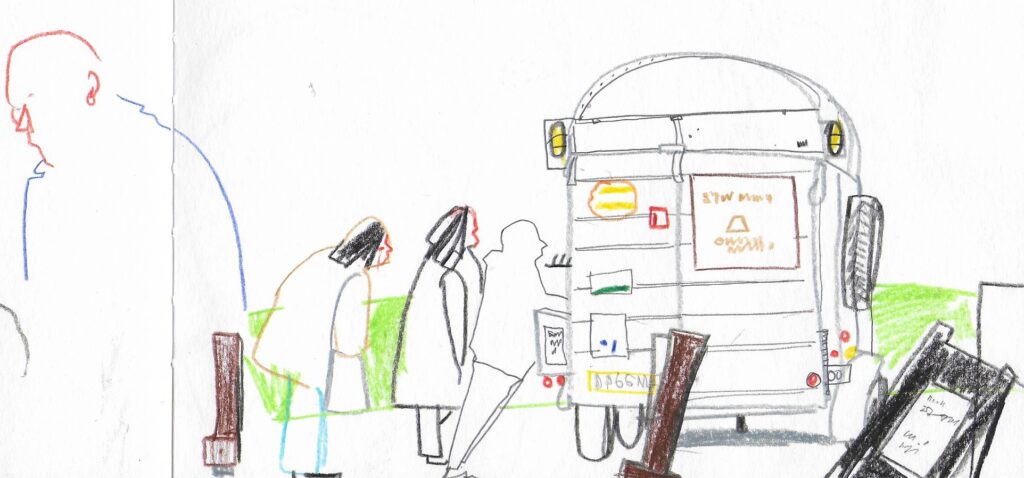
I don’t draw well when I’m fearful. I freeze up. And I watch every line, judging it and shouting it down. There was so much going on. Tent after tent, a hotch-potch of soggy canvas in mismatching colour, all set against the formal, pseudo-Italianate grandeur of Newtown’s Town Hall. To the right of me was a metal truck selling coffees, and, rather surprisingly, sausage rolls. I watched and drew the rather desultory queue that began to form outside it.

To the left of where I was sitting was the ‘Seed Tent’, from which I could hear a very ebullient woman talking to several people about what sounded like ‘rainbow-coloured soup’. A man hovered nearby, seemingly accosting people for a survey he appeared to be conducting.

Families began arriving, coffees and cakes were brought out from the cafe and eaten ad hoc off the metal bollard-like structures outside the gallery.

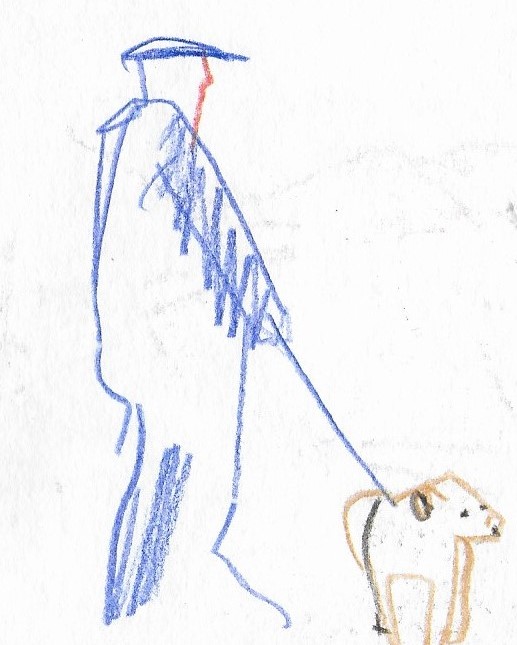
I was overwhelmed. The drumming had started up by then and what with the chattering from the seed stall and the man doing his surveys and the other snatches of music that seemed to pulse from every tent, concentrating on the task in hand was a monumental one. Focus on the detail, I kept telling myself. Zoom in on human stories. Tell your story. I tried, such as with the man out walking his dog who was clearly rather bemused by it all. As indeed was the dog.

I smelt them first. A kind of warm-wet-straw-on-the-floor-of-a-cowshed sort of stink. Two llamas, one of which appeared to be called Cedric. Still egdy with nerves and self-consciousness, I scribbled out a response before they were led off.

On a table behind me a woman, evidently a carer, had seated a man before getting up to greet the woman who I’d drawn in the coffee van queue. Bringing the man a drink from the cafe – what she referred to as his usual “chocolate-coffee” – she bemoaned the fact that there was no sugar. The man said nothing. After settling the woman at the table, the carer bounded up, saying she’d go and bring the car nearer. I watched as the remaining woman stood up and, her handbag held closely to her chest, ambled towards the seed tent only to be intercepted by the survey man.

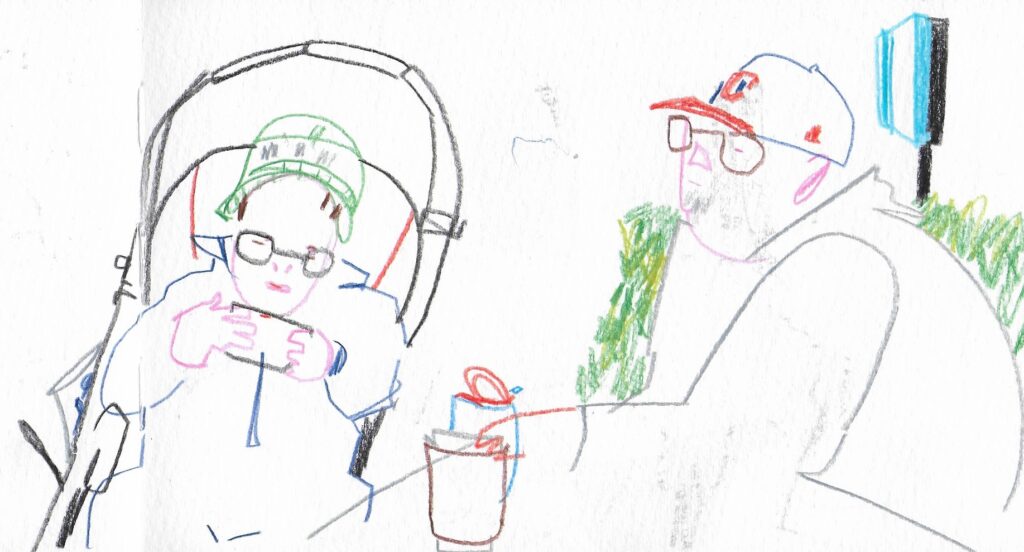
Meanwhile, on the table opposite me, a father sat with his son while his wife went off to do some shopping. Utterly absorbed by some game or other he was playing on a mini device, the little boy made no response to his father’s occasional questions or urgings to drink. I watched him intently. Every now and then his face would break out into a smile and sometimes he’d let out a giggle.

Tired now, I returned to the relative safety and containment of the cafe. It was busy.

Mainly occupied by middle-aged couples, all the tables were taken.

Two men with almost identical grey beards came in. One sat down at a recently vacated table while the other stood in the queue. When he joined his companion he didn’t talk but began signing.

Having exhausted all that I’d had to give that day, I managed a quick drawing of a man in gold-sequinned top hat who’d just joined the queue. I’d had high hopes for my drawing that day. Perhaps I’d expected too much; certainly nerves had taken their toll on the confidence I needed to push myself to rise to the day’s challenges. Nevertheless I’m glad for the Gallery that the event had brought crowds and, despite the weather, had prompted a generosity of spirit and energy.

Categories
Gallery Watching

Rough Sleepers, Opera Singers and Ballerinas

As the ‘Angel’ exhibition at Oriel Davies was due to close that following weekend I decided to visit Newtown first for this month’s drawing day. It felt odd initially, not having the warm-up of a Ruthin trip beforehand, but to be back amongst Claire Curneen’s and Philip Eglin’s ceramics was a comfort. How I love drawing them. There is something about their juxtapostion against the passing bodies of visitors that really excites me. Is it the sharp-edged, distinct white static-ness of them against the seemingly more amorphous bulkiness of the be-coated passersby?

An engagement certainly happens, each staring back at one another. It’s magical.

As ever, I have to draw fast. Though from this particular position, in the archway between Gallery 1 and Gallery 2, I can capture people as they stand in front of a video screen.

I listen to it on its loop throughout the day.

Visitors are clearly captivated.

One man even takes out a notebook and makes notes.

It’s the unlooked-for encounters with the general public that makes this project so rewarding for me. As with this man. I’d seen and heard him first in the main gallery. The sliding door had opened and he’d wandered in. “I thought there’d be paintings,” he announced to the member of staff on duty. She pointed to the Verrocchio and began to explain what it was.

I didn’t hear much more of their encounter but saw him leave soon after. He returned about half and hour later and stopped in front of me. We talked about art. He used to draw at school: “I was quite good at it.” But he didn’t think he’d do it again. He told me he’d occasionally slept rough. “It’s the drink,” he said, “it makes me a bit noisy.” He asked about my pens – “that’s a dip pen, isn’t it?” – and took the lid off one of my felt pens. “Nice talking to you,” he said, as he left.

It was busy. The flow of people was constant.

Kate, Oriel Davies’s Creative Producer, came over to talk about the Spring Fayre next month and the various other projects they will have on while the gallery is closed to exhibitions.

Sitting in the little corridor between galleries I could also hear the soundtrack of the film featuring Adam Buick’s Liberty Bell on its cycle behind me. There’s the intermittent, resonant clanging and gentle lapping of waves as they roll into the cave. Two couples enter the makeshift cinema. The women sit on the beanbags while the men talk in the semi-darkness about fountain pens and India.

A man in a florescent orange kagul stands in front of the video screen, his hands clasped firmly behind his back.

A woman is equally entranced. As was I, with the whole show. I loved it – for both its corporeality and its spirituality. I shall miss it. And then, just as I was packing up, a young opera singer came along. She was to play Gretel in Humperdinck’s Hansel & Gretel that very evening. What a delight she was and how I wish I’d drawn her…..

This was my to be last encounter with Ruthin Craft Centre’s ceramic, shelter and suffragette handkerchief exhibits too. And wanting to capture for the final time the wide sweep of it, I decided to focus my attention on the On Your Table exhibit in Gallery 1.

The incessant rain outside hadn’t boded well for visitors and for the first half hour I had the space to myself. I was happy for it to be so. I wanted to sit with those pots and feast on their elegant restraint without the stress of having to capture some sentient beings.

They soon came. And from then on the flow was constant.

There’s a certain rigid stiffness to the way the visitors engaged with the ceramics. More often then not it involves a hands-behind-the-back lean. Why do people hold their hands like that? Or should I say men? (For it is mostly men who adopt this posture when looking at craft.) Perhaps it’s something learnt from childhood when hands longed to touch but were told they could not. Whatever the reason it makes for a lovely visual counterpoint to the voluptous roundness of some of the pots.

People really look at this exhibition. It deserves their attention and they give it, freely.

I watch this woman perambulate around the exhibition. She makes slow progress and at first I think she is pushing a pram, though it’s hard to see that there could be a child under the various coats and jumpers that are draped over it.

She comes nearer and I can see that it is in fact some kind of ‘walker’.

She stops to talk and explains that she’s just had a new hip after a fall. I learn that she wanted to be a ballerina and was a member of the corps de ballet for a while but when she hit twenty-nine her mother suggested she get a job in the services. She did and became a dental nurse in the RAF. My drawing of her is far from flattering. I’m glad that she doesn’t ask to see it.

Then a man comes along and stops to ask what I’m doing. What a delight he is. Taking out his mini earphones, explaining: “I listen to 24 hour news all day,” he begins to say that he does “a bit of calligraphy” before going on to tell me of a recently discovered son in Australia. Finding a photo of him on his phone, he sticks it under my nose and then proceeds to find images of several of his grandchildren.

The stories flow like a gushing river, tumbling and swirling. What a fascinating life. I am captivated, though in the end I have to tell him that I must draw other visitors. What is it about my sitting there drawing that encourages such emoting? It’s a fascinating question. And I am always touched by the openness of these strangers.

I return my focus to the exhibition and its visitors, wearied now after listening to the calligrapher’s recounting of such a helter-skelter life.

A couple come in. She wanders off into the Suffragette exhibition while he studies each ceramic piece one-by-one.

And consults the price list as he does so.

Spent, I put away my books and materials. I shall miss the gorgeous lines of this show and the way in which the visitors have engaged so carefully and lovingly with what is, in truth, sculpture. Domestic, yes, but sculpture in all its purity of form. Just wonderful. I’ve been blessed.

Categories
Gallery Watching

Childrens’ Homes, Women’s’ Dormitories and Crab Apples.

I’m always surprised by how different each of my visits to Ruthin Craft Centre and to Oriel Davies is. It’s a complex mish-mash of my state of mind at the time, the encounters I have with the visitors and staff, my relationship with the artworks on show and where I choose to sit and view them.

As I’ve said before, RCC’s Gallery 3 is a tricky space to capture on paper, and, indeed, to inhabit. There’s the light from the windows, throwing shadows of grey, sometimes blue, sometimes ochre. There’s the intermittent electronic sliding sound of the automatic door at the far end of the space as people come and go and the fact that it works as a kind of corridor for the larger galleries, often discouraging visitors from remaining. Not so with Antonia Dewhurst’s Gimme Shelter exhibits. They are little jewels of colour, of corrugated detail and impossible to walk past.

The curation is lovely. Sitting on shelves (the artist was in that day and I watched as she tweaked the shelters’ positions, standing back to weigh up each adjustment) the tiny structures appear to float in space. The clean whiteness of the walls and shelves act as a crisp counterpoint to their apparent shabby, ramshackle-ness. They are not. They are exquisitely made.

But, like the space, they are a challenge to depict.

Initially the footfall was slow. Three people eventually arrived and I soon worked out that one was the artist, the other two – a man and a woman – appearing to have a kind of professional relationship, the woman talking about the work to the man as he bent in close or stood back, hand on hips.

Nervous, as I usually am at the start of a day’s drawing, I decided, in an effort to be bold and to counteract this, to use a dip pen. My initial drawings were tentative, scared even, which wasn’t helped by the man and the woman leaning over to watch me. The woman smiled but neither of them said anything. (I later learnt that she was the curator of Dewhurst’s show.)

Providence, it seemed, came to my rescue with the arrival of another man and woman, both of whom were in raptures over the work. Philip, the Gallery Director had said that ‘lots of people were coming today’ including the ex-head of Ceramics at Manchester Met University. It soon became clear that this was him.

It’s such a pleasure to watch people really really look at art. Both he and his companion gave each piece their full attention. Since I was sitting beneath the blow-up of the gallery’s blurb it was necessary for them to acknowledge me as they read.

Asking what I was doing, they showed genuine interest in my drawings, the project and indeed me. “It’s good to see someone drawing,” he said. She agreed and then went on to admire what I’d done so far. (I could’ve hugged her). “Really,” she said, “these are lovely.” I told them I’d studied Illustration at MMU. “I thought so,” she said, “I thought so.”

I observed the two of them from time to time as they wandered around the ceramics show, coming into my view through the doorway that led from Gallery 2 to 3. She took pictures while he leant in, practically breathing the pots in.

Then two women came in, one tall girl in a floral shirt, the other in dungarees and flowery wellies. The floral-shirted woman, a glass-caster, was due to have an exhibition in the space and was checking it out.

Although it was half-term and looking through the window I could see the café was busy, in the gallery it was a day of sporadic visitor flurries followed by quiet.

A few parents and grandparents brought children in, but not many. I saw a man who, though he spoke to some youngsters looking at some photographs of shelters, appeared to be alone. “Are you sketching? ” he asked me, before adding, “I used to be good at art at school.”

He told me that he just been to visit the Car Museum in Denbigh and that he’d seen Christine Keeler’s old Fiesta. We talked as I drew. He was an ex-miner from Rhyl, who’d left the industry after the pit closure to work on the docks – “I had a house and a family to support.” I told him I’d gone to school not far from Rhyl and he said that he’d been in a children’s home nearby. I asked him how old he’d been. “Sixteen, ” he said, “after my mother died of TB.”

He said that he’d come to the gallery on his way home “just to see what’s about.” I thanked him for standing for me, which he’d done so patiently, if a little self-consciously. Apparently content with just conversing, he didn’t ask to see my drawings of him. He smiled at me, inclined his head and left.

Towards the end of my drawing session Antonia Dewhurst and Anna, her curator, returned and asked me about the project. They really engaged with what I was trying to do and I appreciated it. A good, good day.

The anticipation of being filmed while drawing at Oriel Davies heightened my usual pre-drawing day jitters, with that perpetual fear of ‘What if nothing happens?’ or ‘What if my hands won’t or can’t draw?’ increased tenfold. As the filmmaker, Pete Telfer of Culture Colony, mic-ed me up he assured me that he ‘was used to it’, that ‘he’d seen worse’ and that I’d hardly know he was there. He was wrong. I did.

But I was there to draw. So draw I did and with dip pens mostly – my ‘make-it-more-difficult-for-myself-and-therefore-think-less’ default on such occasions.

The gallery was busy and I found myself switching from drawing Clare Curneen’s figures (I was sitting directly behind them) to drawing the visitors. Oh, how I love this show – there’s so much to engage with on so many levels. And I could draw her angels and Philip Eglin’s statues over and over.

The gallery’s busy-ness was mostly down to half-term which brought in gluts of children being ferried their parents into Gallery Three for story-telling, first in Welsh and then in English. I could hear a harp as I drew.

There was also a ‘give-away-a-tree’ event outside the gallery, the first concrete evidence that I’d seen of the Welsh Government’s promise to donate a free tree to every household in Wales.

The angels surveyed the comings and goings with their usual sanguine aplomb. And I just drew. And drew.

Visitors seem to linger at this show, even the passers-by en route to the shops or the bus station. It seems to captivate, to engage a whole demographic.

Two children skitter out from the story telling and stand still just for a moment to stare up at the suspended wingless angel before skipping off.

A little girl in a pink woolly hat with mouse ears stands in front of me, evidently intrigued by what I am doing. “She likes to draw,” says her mother. I ask the girl what she likes to draw. “Witches,” she says. What kind of witches? I ask. “White ones,” she replies, “like my Mummy.”

Two gallery volunteers arrive to take over the afternoon watch. They’re husband and wife. He talks to me as I draw him, telling me of their fascinating life, including a five year period which they both spent teaching English in Kosovo (I think). Laughing to himself, he also told me of the time he stayed in the women’s dormitory in Aberystwyth’s University. “The women weren’t there, I hasten to add,” he said.

Can I admit that I love this kind of drawing? It’s hit and miss, of course, but it stretches me; it’s urgent immediacy means I have to get beyond my destructive mind and just draw, pushing myself to capture the essence of the person before they threaten to move away.

Such was the case with this woman. An illustrator herself, she said that she’d been following my postings on Instagram and was enjoying them. She was carrying two trees in a small plastic bag. “I’ve only a small garden,” she said. She told me one of them was a crab apple.

While he wandered around, his wife, the other volunteer, stood guard over the Verrocchio.

A rather commanding presence, she appeared to both field and answer questions.

Did I hear her tut when a mother removed her child prematurely from the story-telling session because it “was too frightening for him”?

It went OK. And Pete was great. And I drew, which in the end is all I ever want to do.

Categories
Gallery Watching

Ceramic Enchantments

Drawing in Oriel Davies against a backdrop of Jacki Poncelet’s and Philip Eglin’s work. Photo: Pip Jones

Having been commissioned to write a review of two of Ruthin Craft Centre’s three new shows, I was already familiar with their ceramic exhibit On Your Table when I arrived for my fifth drawing day.

As the title suggests, most of the work in Gallery 1 is placed on table-like plinths, most at hip-height, or on shelves along the walls, making it a much more focussed use of the space and a very different challenge to that posed by Helen Yardley’s mostly wall-hung rugs.

Almost six months into the project and you’d think I’d be over my nerves by now. I’m not. In fact, sometimes they feel more acute, sharper. As a consequence the first few drawings are hesitant, scribbly and I long to throw myself and my sketchbook on the floor and kick and yell. I can’t and don’t of course and instead sit there making my marks and hoping, sometimes beyond hope, that things will improve.

The opening of the doors bring a flurry of people who bend over and peer into the bowls, jugs and cups on display.

Many look suspiciously like potters, particularly the tall woman in the black bobble hat who studies every pot with careful attention. Many take photographs.

The ceramics are divine and I want to eschew my so far failing attempts to capture these rushing animate beings and draw the pots in their calm, elegant stillness instead.

A couple stop to talk to me, one of whom is wearing an exquisite Scandinavian-style cardigan. “She’s an artist,” says her husband. “Yes,” she says. And then goes on to explain how she studied Zoology but ended up teaching. I ask if I can draw her as she talks. She reluctantly agrees and then begins a tale about some distant members of her family who had a small-holding in rural Wales. “One of the women used to travel to Newtown to sell her butter at the weekly market there. She’d rent a room for the day to eat her sandwiches in.” Then there was another woman, a great-aunt, I think, who, being “crossed in love”, took to her bed, staying there for twenty years tended to by her sisters. Eventually the stories run dry. “Can I go now?” she asks.

There’s a pause in the flurry and I draw Mizuyo Shamashita’s beautiful line of tall-handled vessels.

And then Irena Sibrijns’ collection of bowls, jugs and cups. Her mark making is so joyous.

I move to the other corner of the gallery. I find I can only draw one section at a time – an overview of the whole show is beyond me today. Then I hear the Lost Art Group (a support network for people with dementia and their carers) gathering in Gallery 3.

I watch them make their way into Gallery 2. They lean into the leggy black cabinets containing the suffragette-inspired handkerchiefs. I hear some them sharing stories about their female relatives from that era.

A man with a blue paper mask under his chin, his hands clasped behind his back, stops to look at what I am doing. He smiles but says nothing.

After three and half hours of drawing I’m spent. I’m not satisfied – I never am. But it’s all I can do today.

It’s my second visit to the Tobias and the Angel show at Oriel Davies, and even though I know what to expect, I am still nervous. Thinking it would give me a view of entrance and people going into Gallery 2, my plan was to sit in the corner behind Philip Eglin’s three figures. It was a decision that I immediately begin to doubt as most of the visitors naturally make a bee-line for ‘The Angel’. However, I stay put and start to experiment with placing Eglin’s figures in the foreground and treating the Verrocchio ‘worshippers’ as shadows.

There are so many nuances and textures to this show that cry out for a mixed media approach: the brittle whiteness of Claire Curneen’s figurines’ hands, the glazed shine of Eglin’s blue-splashed Madonna and Child, the creased and pleated curls of Cecile Johnson Soliz’ paper forms and the razor-sharp, ossified sinewy-ness of Beverley Bell-Hughes sea sculptures. I just need the courage to experiment and possibly fail.

A man strides into the gallery, a manuscript under his arm. He is impossible to capture.

A young woman stops to talk to me. A little diffident at first, she tells me that she began a Fine Art degree but left due to mental health issues after the first year. She still draws.

The striding man returns with a female companion. He brings her over to the Eglin group. “They’re probably too expensive, “she says.

One of the OD’s volunteers is doing a tour of the gallery with a woman walking with two crutches. He talks loudly and volubly about Verrocchio and the Angel. Peering in at one of the small Rembrandt prints the woman on crutches remarks that the dog reminds her of something. “I can’t think what it is, a white dog. In a comic strip…?” “Snowy?” I say, adding, “from Herge’s ‘Adventures of Tintin.” “That’s it,” she replies, evidently delighted.

The same woman stops to talk to me on her way past. I ask if she’s an artist too. “Yes,” she replies, “and I really understand how difficult what you’re trying to do is.” I find myself taking real heart from this.

A seemingly VIP group arrive in the gallery complete with their very own photographer.

Meanwhile I get lost in the ceramics. I love the white against white with the splashes of colour from Jacqui Poncelet’s papery curls and Eglin’s gorgeous blued Madonna. So much of what I am trying to do is about art in space. Sometimes the visitors are almost a secondary concern, inhabiting the temporary aesthetic as umbrae.

I want the stillness that the artworks offer, as the rushing about seems somehow inappropriate. Some stop and look, engaging face-to-face so to speak.

I stand up and move around the gallery with my small book and sketch another woolly-hatted woman gazing at a drawing of hands. Hands are everywhere. (I want to study them in more detail next time).

A blur of figures engage momentarily with Curneen’s angel, whose wings are bent and broken.

An almost empty gallery and I watch as the volunteer on duty gazes at the Verrocchio.

Ah, Eglin’s Madonna….

A quick break and a visit to the café/warm space where I draw Steffan, the director, lunching with Shani Rhys James, Stephen West and Ellie Evelyn Orrell.

A battle of a day and I am too tired to make sound judgements. All I know is that I long to return to both RCC and OD and do better…..

Categories
Gallery Watching

Helter-skelter-ing

I knew that this project would bring ups and downs. There would be quiet days, visitor-less days, dead nothing-much-happening days, of course.

But, in truth I’d had no plan as to how I might deal with them.

There’d been snow on the mountains on the way into Ruthin for my fourth drawing day. The air was cold. The Gallery was cold and, unsurprisingly, empty.

Having decided beforehand to spend that day working in Gallery Three (a tricky space to represent with its long-corridor like shape and wall of floor-to-ceiling windows) I spent an hour trying to capture Helen Yardley’s hanging rugs with their ‘dancing’ marks. I’d hoped to distract myself, only too aware of the panic that was beginning to bubble up inside of me. It was a hopeless business. I was cold, disconsolate and scared.

Caving in, I went to the desk. “I need people,” I said to Gareth or was it Paul (apparently visitors always mix them up too), “so I’m going to the café. ”

Warm, the Café R buzzed with life. It felt like another universe. Who were all these people, sitting down to their too-early Christmas parties? Was there ever any crossover? Bellies full, would they go and look around the Gallery afterwards?

Comfortable though it was, I was nevertheless unsettled. Should I be there or not? Was I betraying my intention? The project even? Could Café R legitimately be regarded as being part of RCC? It affected my drawing. I couldn’t focus.

In the end I decided just to draw – to, in effect, draw myself out of the hole that I’d begun to dig for myself. I’d wanted people and here they were. Like the man in the peaked cap and dark glasses who kept his coat on throughout, staring at, and mostly not drinking, his latte.

Or the man eating a huge beef burger, completely engrossed in its consumption.

Or the woman with black shiny beehive who came in with her mother.

I drew and drew. Sometimes calmed by the action of my hand, and for brief moments, lost in it. But I was bereft. It felt like a failure.

Returning to the Gallery to pack up my things, a man came in. Grabbing a pencil, I quickly drew him as he moved from rug to rug, looking at each one in turn, stepping in close and then stepping back. Eventually he came near to where I was sitting and smiled. “Wonderful, aren’t they?” he said.

Packed up and ready to go, I went for one last look at the rugs in Gallery One, conscious that it would be the last time I’d see them. An elderly couple came in. He wandered around, shopping bag in hand, while she sat on one of the benches. I grabbed my sketchbook and graphite pencil. It was enough.

The following day my visit to Oriel Davies couldn’t have been more different from either RCC the day before or, indeed, OD the month before. Here was energy, excitement and even, at certain times, something like joy.

The new show – a response to the National Gallery’s loan of Andrea del Verrocchio’s Tobias and the Angel – is a marvel. There is the ‘Angel’ itself of course and various other old Masters, such as a Rembrandt print, and some exquisite ceramics by artists such as Claire Curneen, Philip Eglin and Adam Buick (including his fabulous film).

There was so much to take in. I was made heady by it. The shiny black ‘altar’ at the far end of Gallery One, on top of which stood three of Curneen’s pieces (with another one hovering above it), took my breath away.

Determined to focus and concentrate on the job in hand however, I positioned myself opposite the Angel painting and waited for visitors. They soon came, and in a gloriously steady stream.

The first couple included an American woman who appeared, from what I could overhear, to be either a teacher or lecturer. They were in raptures.

The man was particularly entranced by the detail of the fishes, something he hadn’t noticed until accepting the offer of a magnifying glass.

Then there were the pair from Birmingham.

He did all the talking, while she, hanging back slightly, listened obediently.

An artist himself (or so he informed Deborah, who was there in the gallery throughout, tirelessly repeating the same information over and over), he was loquacious and, indeed, seemingly well-versed on the subject of Verrocchio, the painting and the Renaissance. (Deborah told me afterwards that he’d shown her a picture of a copy he’d made of – was it the Mona Lisa or The Birth of Venus? – adding, “And it was quite good.”)

I was captivated by them – his apparent dominance and her almost mute acquiescence and the interplay of their gestures and body language.

However, some visitors seemed more entranced by the other works.

The majority were men. I watched them come in through the sliding glass door, generally with rucksacks on their backs, and stand, arms folded in front of one piece or another.

I thought about how like a stage a gallery is, with its entrances and exits and the way in which the visitors (like actors), inhabit and behave in the space. From my experience so far, both in RCC and OD, visitors invariably race around galleries. It takes a lot to keep them still, static, rapt. Perhaps it’s about finding one’s comfort zone or something familiar and safe. The Angel seemed to do that for people, inviting a stillness and a kind of permission to get in close. But for many of the male visitors that I observed, it was the ceramics that really captivated them.

Such as the tall man who kept returning to bend over Beverley Bell-Hughes’ forms. Leaning right in, with a Tesco bag clutched in his hands behind him, he held his body at virtually a ninety-degree angle.

Though a relatively small space, particularly in comparison with RCC, I felt nicely invisible in OD. There was so much to entrance and attract those who came that me sitting there (even with all my paraphernalia spread out on the floor in front of me) didn’t seem to phase them at all. As a result my usual chronic self-consciousness dissipated and I drew continually, without stopping. It was both exhilarating and exhausting.

I was asked again that day what I intended to do with my sketches and whether they would be ‘worked-up’ into a bigger paintings.

I answered no, as I always do, but it did make me wonder what I intend to do with this project and the body of work it generates.

For me, certainly at the moment, the making of the drawings, that intuitive response to what is happening in front of me, is the work. The drawings themselves are almost a by-product. If they become anything more, might their spontaneity be lost? As I’ve written before, it all continues to be a bit of a hit and miss thing .

I wait for the magic, always. But it is rare. Sometimes, I feel it inside but fail to communicate it on the page.

For now all I can do is draw and draw and draw and then maybe, just maybe, that magic, that marvellous spark, will happen.

Categories
Gallery Watching

Challenges

The rain was lashing when I got to Ruthin. Who on earth would come out in this? I set up in Gallery Two, in the corner to the right of the back wall where a video of Helen Yardley was being projected. The carpets in this space were smaller, more like rugs and almost monochrome, with one wall dedicated to her design drawings. I’ve always liked this space; it’s more intimate, less exposed than Gallery One. I began drawing a set of three very Victor Passmore-esque works hanging on the opposite wall and waited.

I was in a prime position. That gorgeous pink (a colour that Helen Yardley refers as Watermelon Pink), red and khaki green carpet hanging on the far wall of the Gallery One was visible, framed by Gallery Two’s arch and I was ready to capture all the visitors who entered either from the reception and shop area or through the doorway from Gallery Three. A few people straggled through but the morning was quiet.

Generating the energy necessary to perform (and this is undeniably a performance) is tricky when nobody comes. Yes, I can draw the paraphernalia of the Gallery and indeed I did for a while, focussing my attention on the projector hanging about the doorway. But ultimately, I need life – beings, animate bodies – to fire up my creativity. And yet I knew that such hiatuses would be the reality of this project and that I’d have to make of them what I could. Then Philip Hughes, RCC’s director, came over to say hello, so I drew him.

In fact I drew him a few times.

His arrival stopped the sinking. It sounds overly dramatic but it is true. It takes a lot out of me to do this. I’m on show, I’m performing and I need people to observe and respond to. So, until they came, Philip was my quarry. I like the permission that this project gives me to be brazen about drawing people outright. I’m a naturally diffident person and if someone that I’m drawing notices me I often lose my flow and even stop. Most humour me – some smile, some ask outright “Are you drawing me?” some look away, and some (like the woman in the Tate St Ives café saying very loudly, “I can’t bear being drawn,”) shift their positions entirely so that I could no longer see them. It’s their prerogative, of course and from their perspective it may be seen as a kind of stealing. Whereas I see it more as a celebrating – a desire to know, to understand, to empathise, to enter into the spirit of someone’s life and experience through the capturing of their features, their stance and the way they engage with the environment they find themselves in. Perhaps I am being fanciful.

After lunch the trickle of visitors became a more satisfactory stream. Mostly middle-aged couples, many took advantage of the bench in front of the projected film to rest and, ultimately, to watch.

Many were regular visitors. “I never miss a show,” one woman said, “they’re always so good.”

Helen is an articulate woman (I can vouch for this because I must’ve heard the audio from the film about thirty times during that day) and the people who set themselves before it listened attentively. Many were quiet, gentle women like the one who came with her husband who initially asked me if I was the artist. “Yes,” I said, misunderstanding her completely. “How does it feel to see all your carpets exhibited like this?” was her reply.

It always interests me to hear how people expect artists to behave. Would Helen Yardley go to the trouble of sitting in a corner of the gallery, as I was, to make drawings of her work when she could be doing so (if she felt so inclined) from the comfort of her studio? It is sweet though. And in both RCC and OD people have asked me the same question over and over. After we had each laughed at the mistake she went on to tell me how she’d had to ‘work’ on her husband to get him to come that day. “Going to see a load of carpets on a rainy Tuesday was not exactly an exciting prospect for him, ” she said. “It was the same with the silversmithing show and the Andrew Logan one.”

I watched him looking at the work. Did he like it?

I observed them part go to different ends of the galleries and then come together again – it was like a kind of slow dance. They’d talk about the pieces (particularly the drawings) in low voices or just stand there in silence, looking.

As they left he’d wrapped his arm around her.

The visitors engaged with me more than they’d done when I was working in Gallery One. Perhaps it was, as I’ve said, the intimacy of Gallery Two, or maybe after the watching the video they were inspired to talk and share their thoughts. One particular man stood in front of the projected video for sometime before turning to me and saying, “it reminds me of the women in Darjeeling with their hands moving so fast making the carpets.” He went on to tell me of the many trips he and his wife had made India in order to ride on their narrow gauge railways. This particular trip had involved a journey on Darjeeling’s Himalayan Railway during which he’d seen a group of women weaving carpets. A real railway enthusiast (he was the second one I’d encountered that day) he waxed lyrical about this passion for some minutes while I drew him.

“Perhaps I ought to go and find my wife,” he said eventually.

Wednesday at Oriel Davies proved to be even more of a challenge. I’d been warned that there they would be between shows but I’d expected at least some footfall. The opening of the long-awaited café (Relish, their original café, had closed as a result of Covid, I believe) had been a short-lived affair, sadly. So the only thing to tempt people to visit was the shop and the opportunity to make angels to paste on the gallery’s windows in anticipation of the next show (a National Gallery Masterpiece loan of Verrocchio’s Tobias and the Angel). I laid out my pens and paints on a table in the vacated café, made a quick sketch of Carol at the reception desk before embarking on a drawing of the bus station outside and waited for something to happen.

The gallery, in an effort to save money, had turned down the heating and it was freezing. My spirits sank.

I always try to generate opportunities to ‘warm-up’ prior to beginning a reportage session. Embury and Minchiniello in their book Reportage Illustration endorse the importance of this. For me it’s not only about loosening up my hand and sharpening my brain but trying to slough off the fear and self-consciousness. Finding adequate places to observe and draw people is not easy. En route to Ruthin there’s a Starbucks and a ‘Drive-thru’ coffee place at Rhug, though at 8 am they are far from busy. Newtown is trickier. There’s a Costa Coffee but it’s dark and with lots of blind corners.

Jack’s Café proved a better option and I spent an hour there drawing the series of mainly men reading papers or their phones and drinking coffee.

But it was a loosening-up that was fast threatening to go to waste once I got to the Gallery. Then a woman came in having planned to hold a business meeting in the café. She let me draw her as she texted her client.

After about half an hour a man came in through the front door and marched straight to the reception. Hearing him ask after me (“What’s the name of the artist working here?”) I recognised him as the ex-teacher who I’d had a long chat with the last time I’d been there. He’d come in specially to show me a printout he’d got about Shani Rhys James’s mother. His arrival made my day. And I drew him and drew him and drew him.

(At one point I even followed him into the shop where he’d gone to enquire about some Chinese ink.)

A thoroughly engaging man, he told me he’d been a steel worker in Port Talbot before becoming a teacher and that he’d spent some time living in France. Seeing me draw him he asked “How much are you getting from this grant – perhaps you should give me some?” I didn’t want him to go: he’d brought energy and a frisson of jocular banter to my morning. “Can I go now?” he asked, grinning. Reluctantly I had to acquiesce.

A few people dribbled in, mostly to look at Christmas cards and gifts.

Others came expecting an open café but soon left.

For the all the disappointment of it, drawings were still made. And that was, is, the important thing. And next month there is my final encounter with Helen Yardley’s work at RCC and OD’s ‘Angel’ show to look forward to.

Onwards.