Categories
Gallery Watching

The Second Day – Shadows

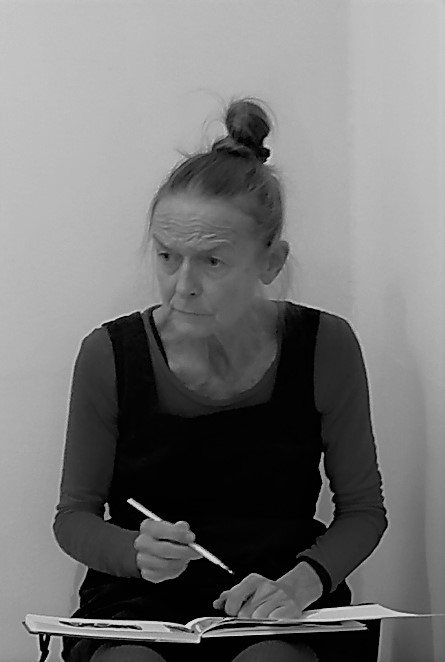
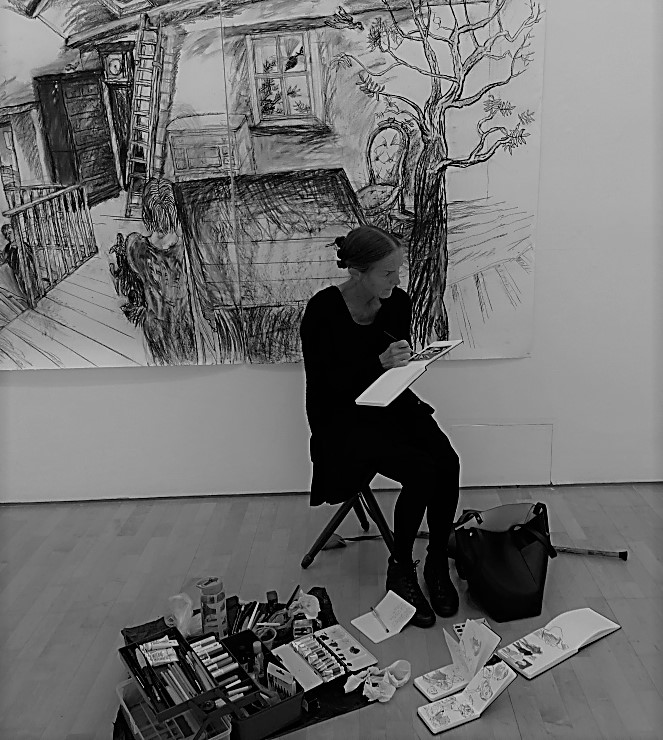
Drawing at Ruthin Craft Centre, 18.10.22 (photo: Pip Jones)

As with all live creative projects it is the unexpected happenings that prove to be the most rewarding.
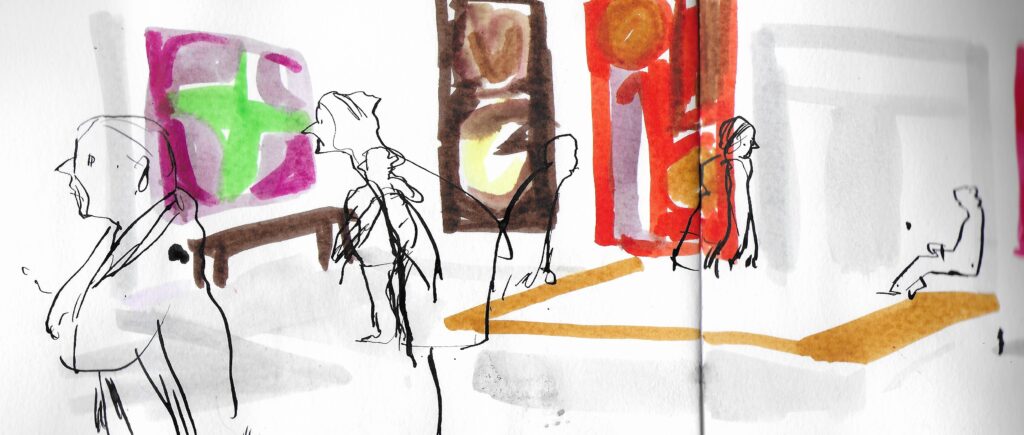
I’m still a jangle of nerves when I arrive. It’s a kind of stage-fright borne out of a fear that I won’t deliver, my hands and brain will freeze and my drawings will be as dead as dodos. But when I get there (and so far this has applied to both Ruthin Craft Centre and Oriel Davies) and I’ve set out my materials, breathed and then looked around me at the work, I begin to forget my self-consciousness. It’s what I wanted, this precious opportunity to sit among art and absorb it and in this my two second visits, did not disappoint.
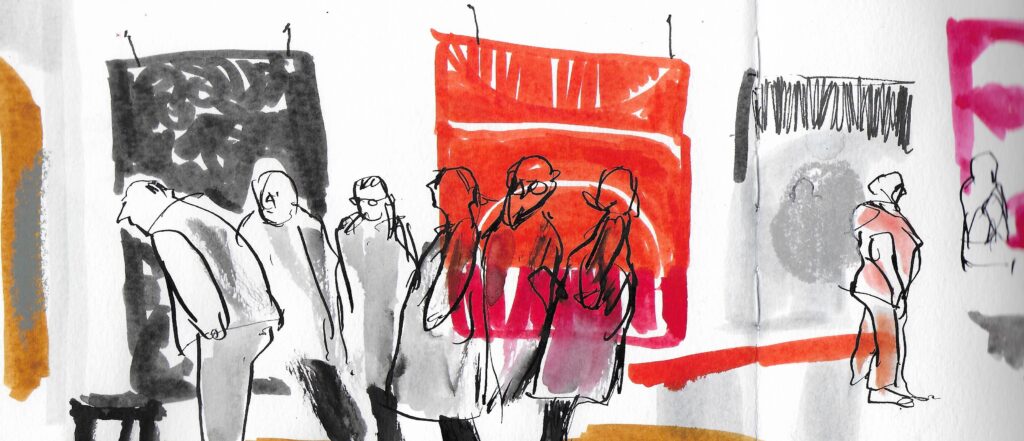
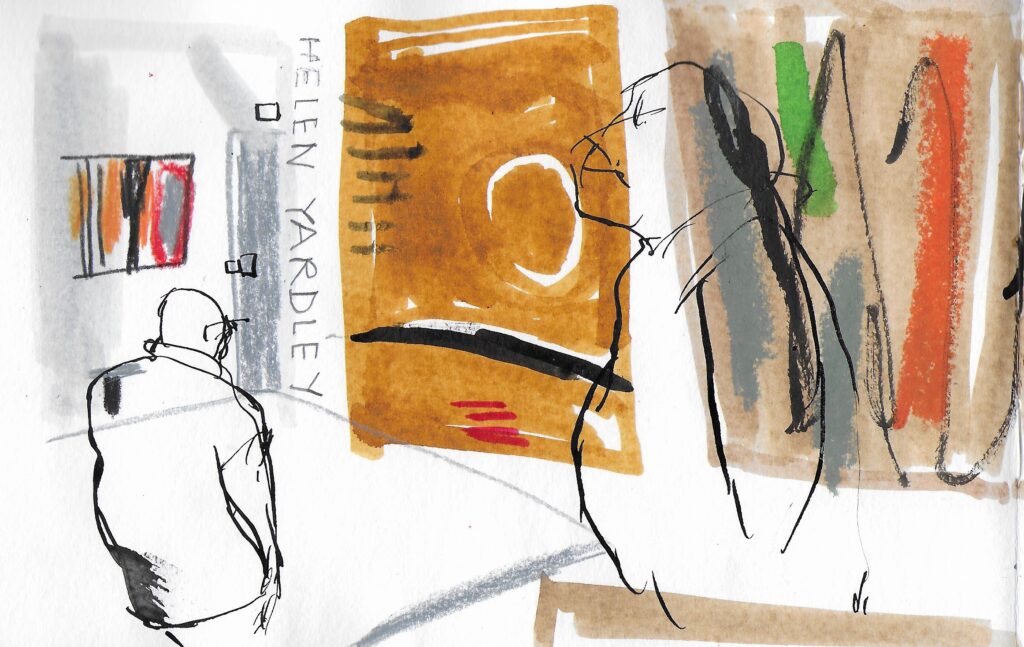
Helen Yardley’s solo show of carpets that filled RCC’s three gallery spaces is stunning, with both floors and walls awash with sumptuous colour and gorgeous mark-making. I scrabbled in my box for inks and paint brushes and I was off. The footfall was slow: the sun was shining, I could see through Gallery 3’s window groups of bikers, parents with children and the ubiquitous ‘ladies-who-lunch’ sitting outside on the courtyard benches. It didn’t matter for I was entranced.
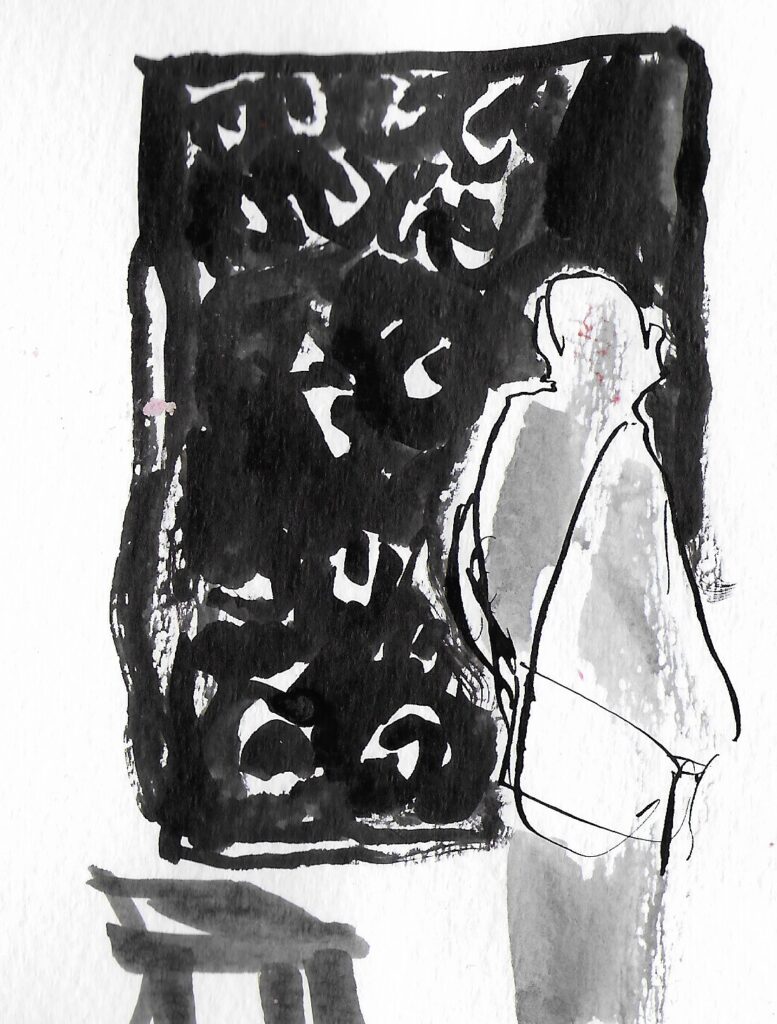
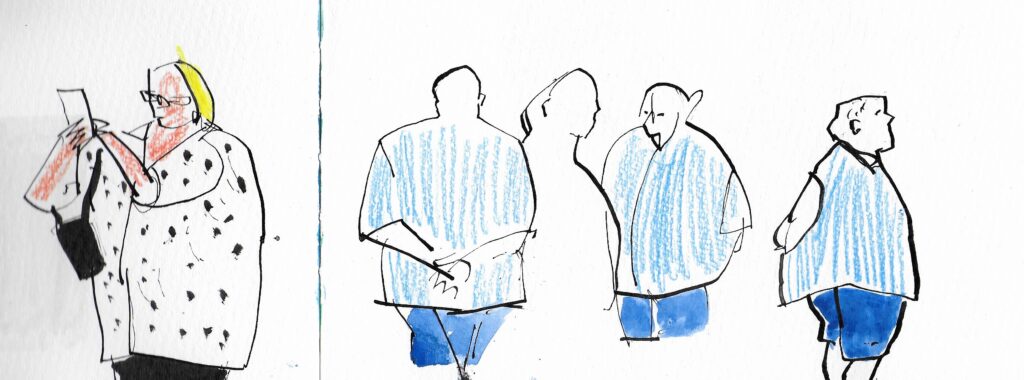
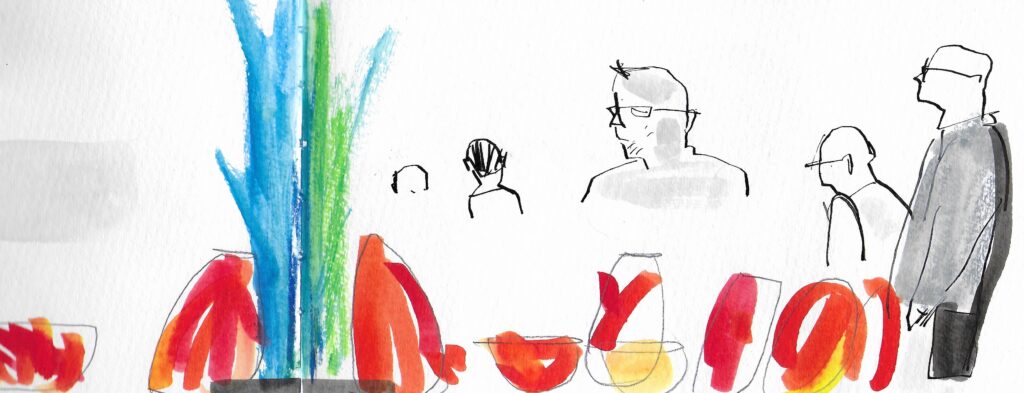
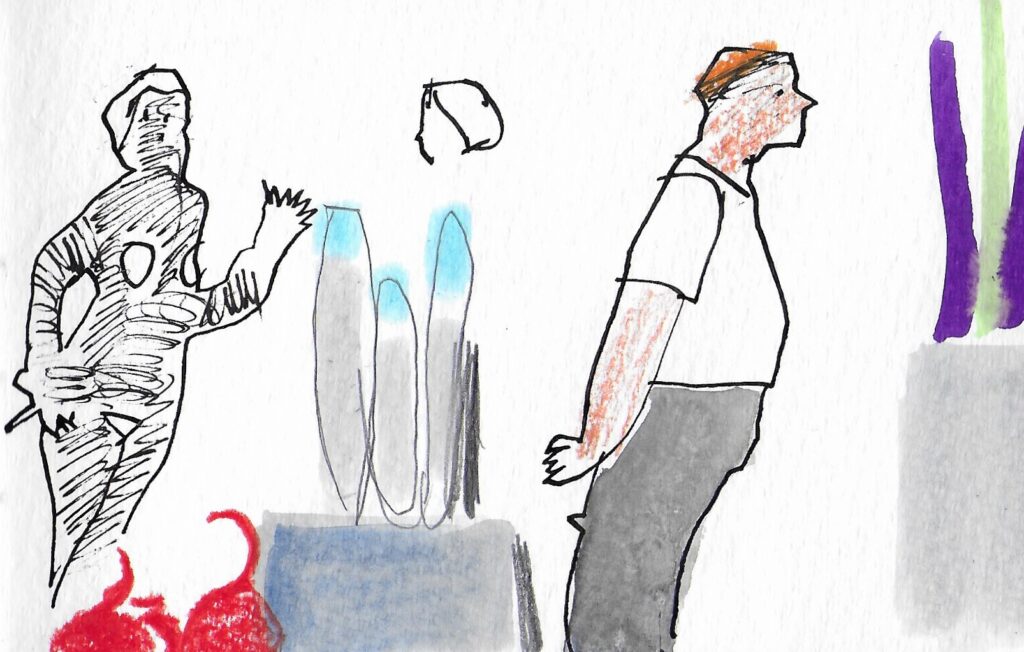
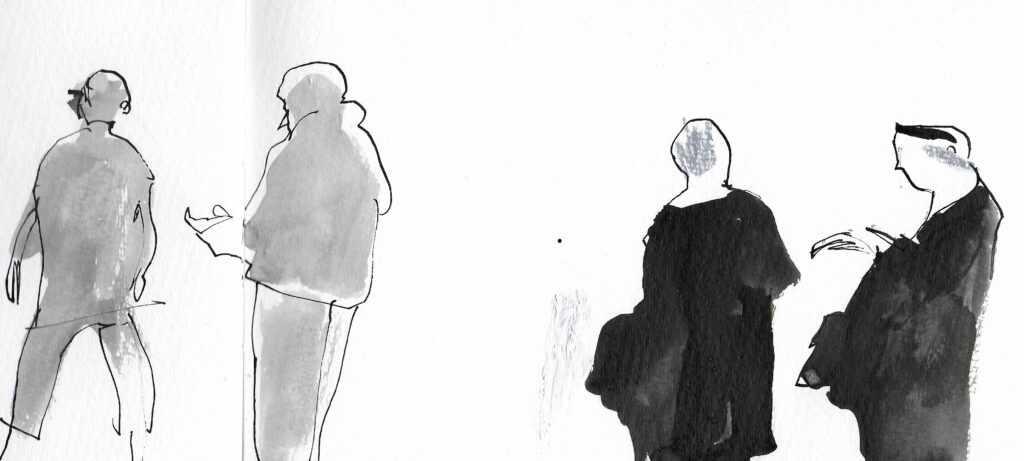
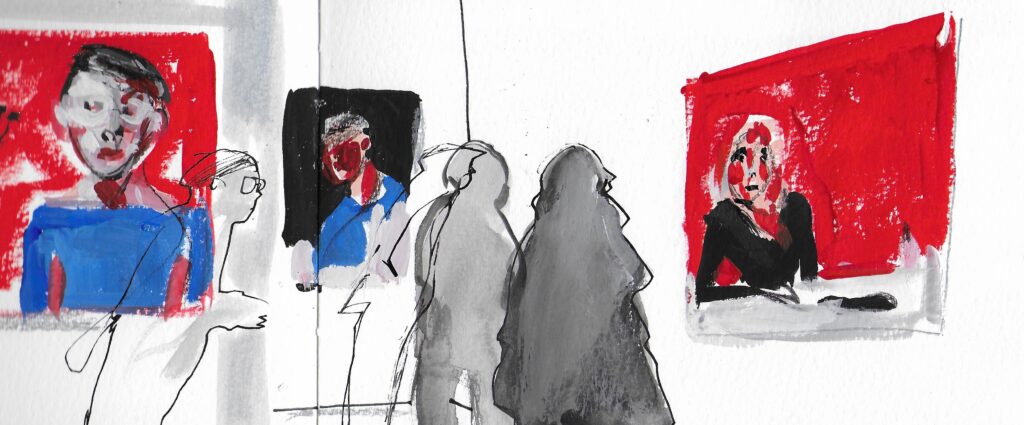
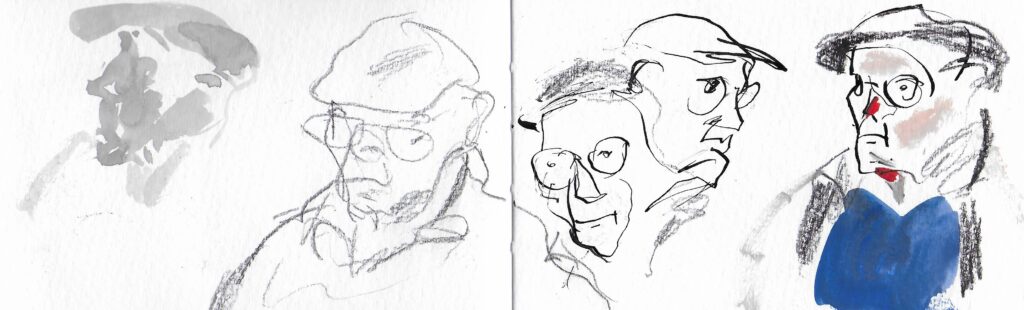
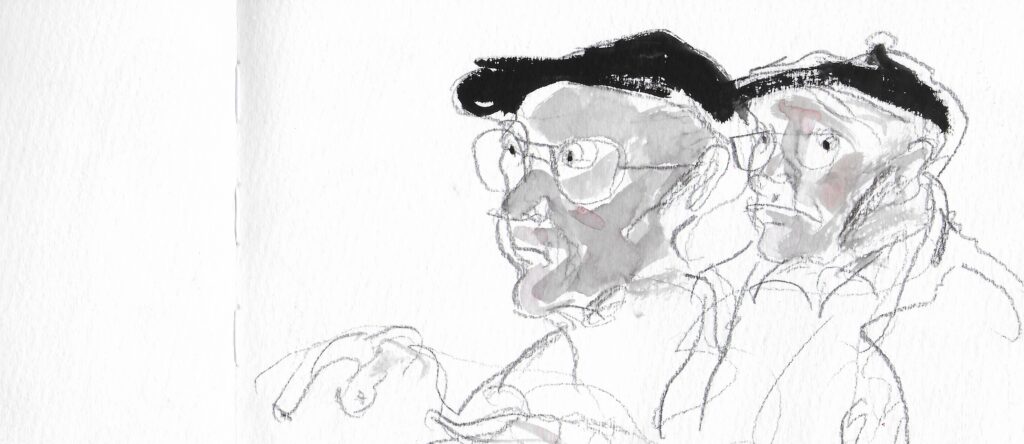
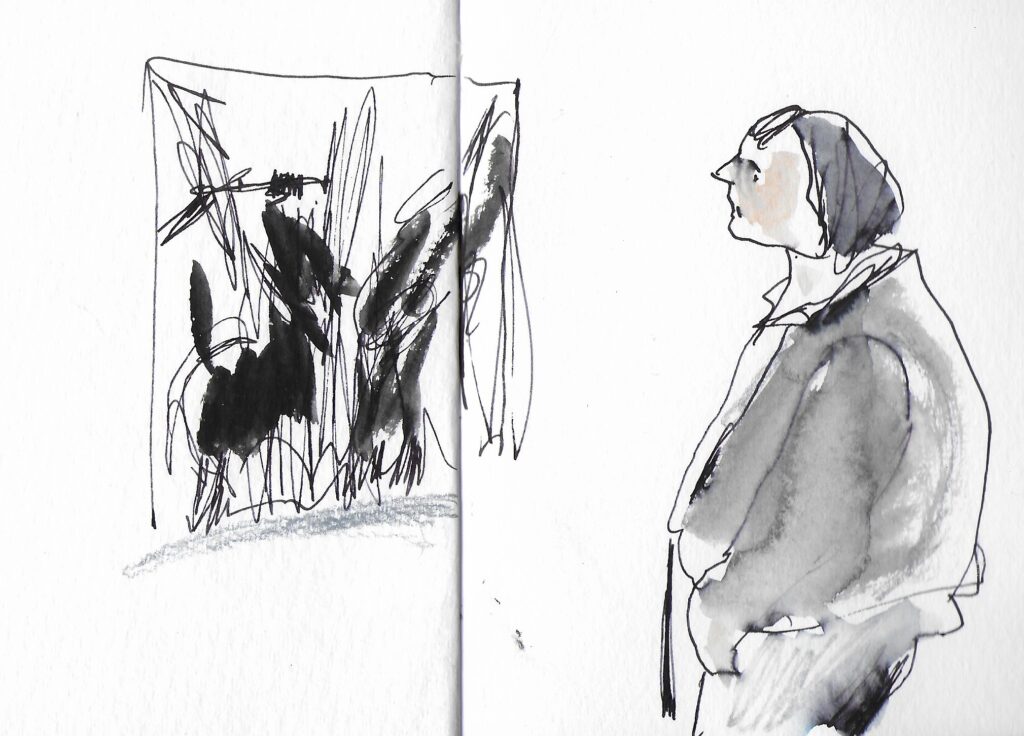
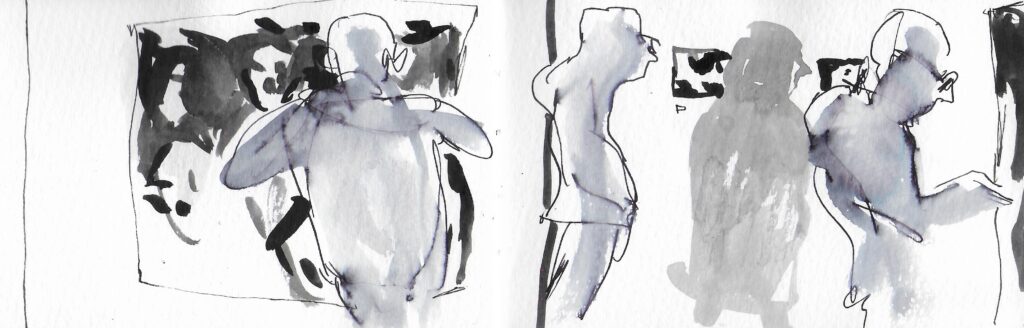
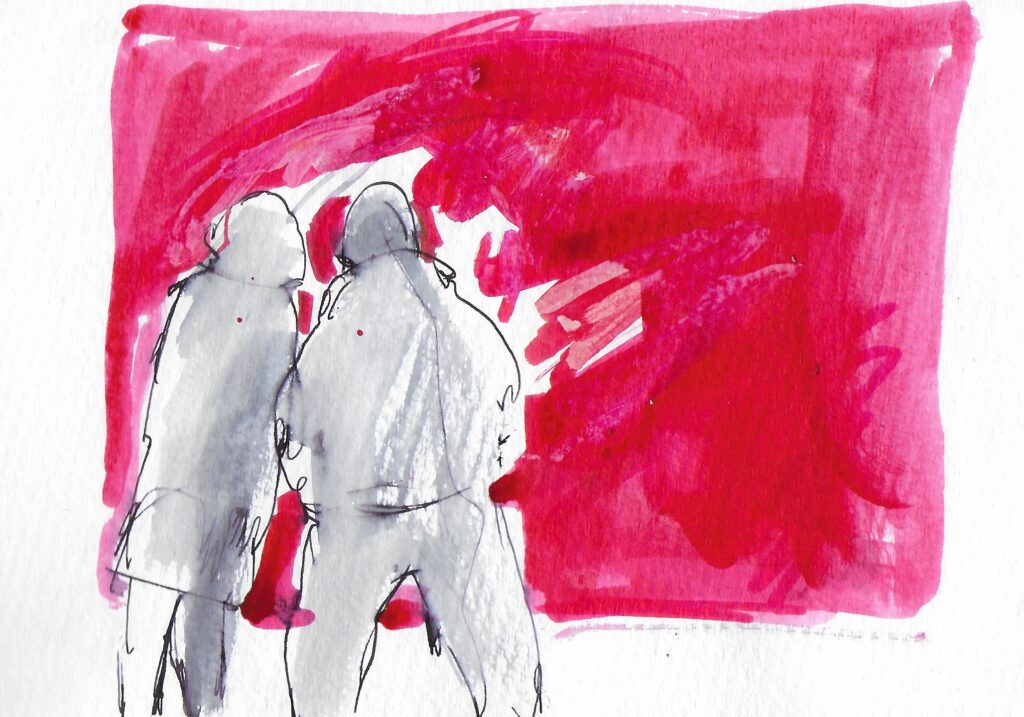
When the visitors did come (why is it always in a rush and several at once?) I was very conscious of the gorgeous juxtaposition of human form against the gestural marks and colours of the carpets – so much so that the drawings I made of the visitors became almost shadowy. Here, as in Oriel Davies with Shani Rhys James’ & Stephen West’s painting and drawings, the art dominated, seeming to sap the three-dimensional life and colour from its viewers.
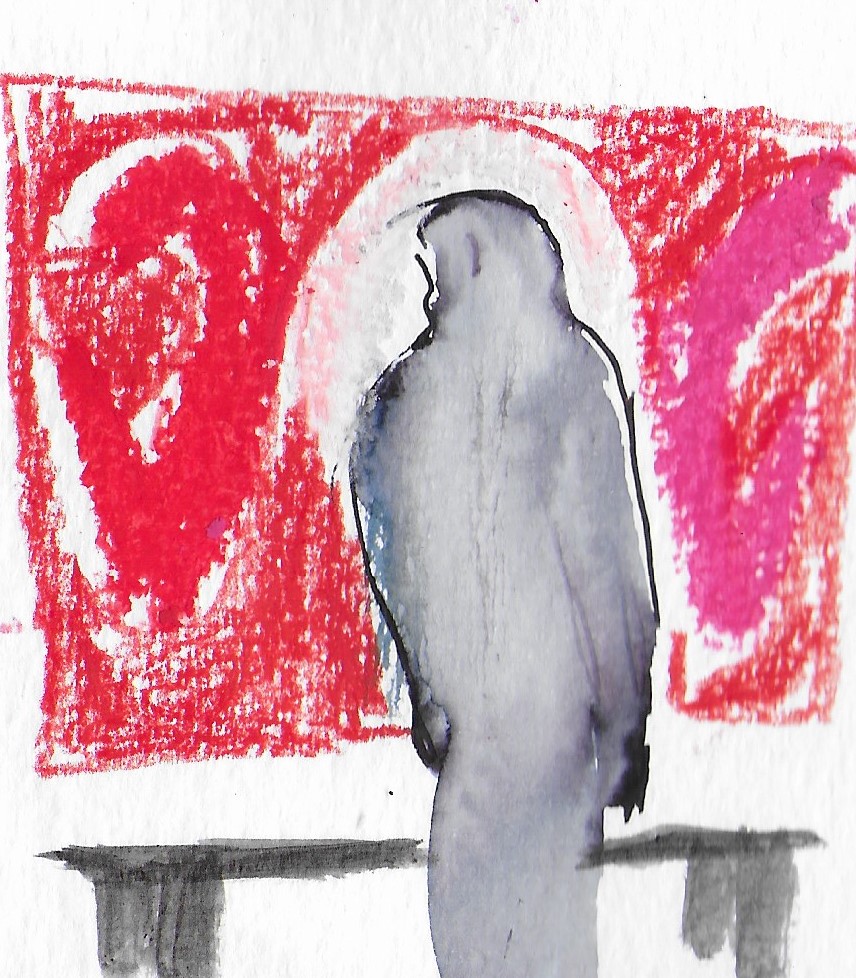
For all the drip-drip of visitors at both RCC and OD, I still had some lovely encounters, like the Scottish woman at RCC (did she say she was from Aberdeen?) who now lives in Australia and who made a beeline for me, striding across the floor saying “Are you the Ellen Bell who writes for Embroidery magazine?”
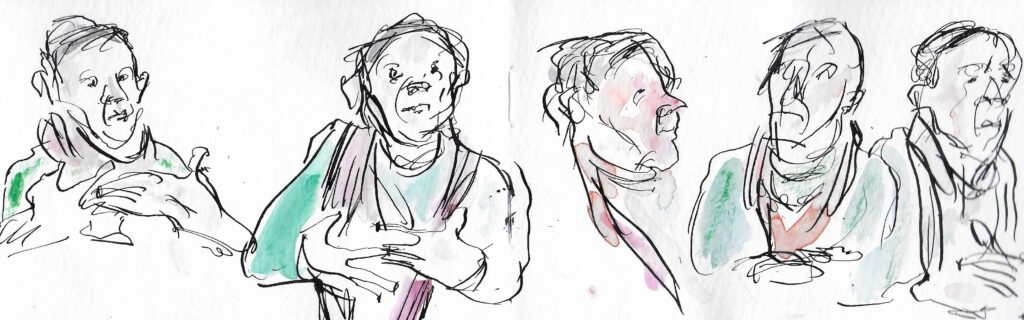
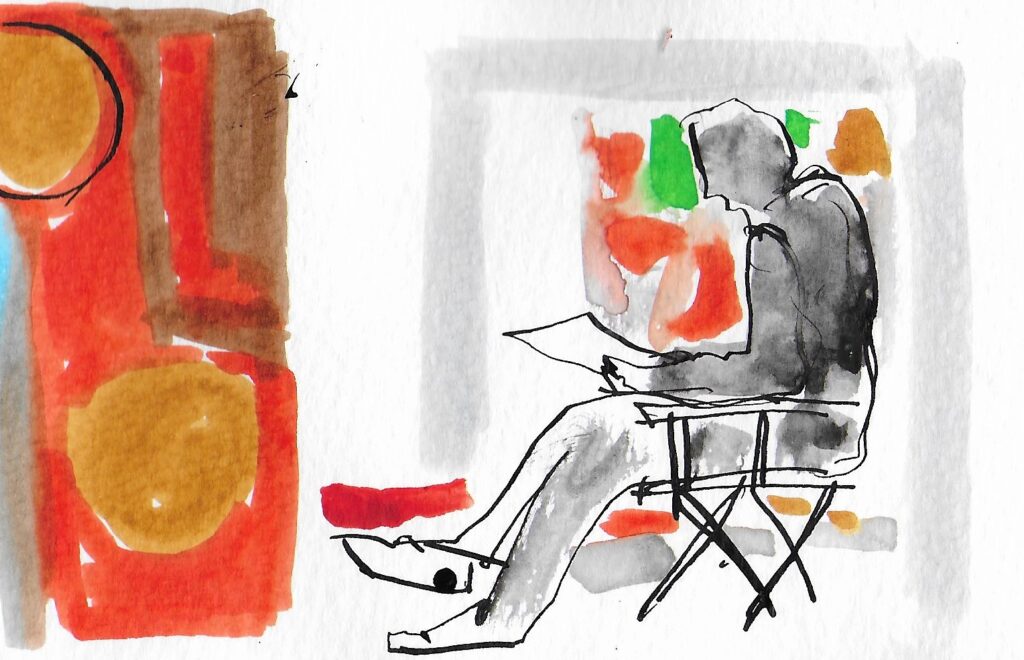
A woman who quivered with life and energy (I watched as she circumnavigated the gallery, darting back and forth, as her husband sat reading the paper) she let me draw her as she spoke, breaking off at one point to ask if I wove, before telling me that she was a ‘free-knitter’. Later, she crossed the floor towards me once more, calling out “Does anyone know how many hand-tufters are left in Yorkshire?”
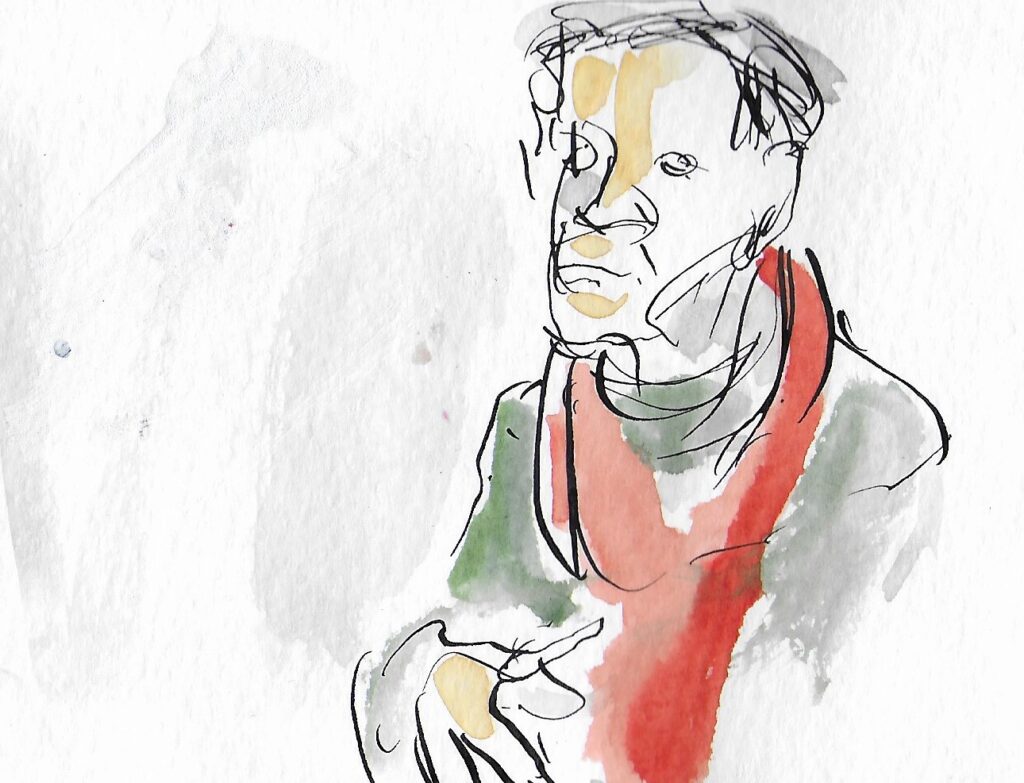
And then there was the artist and educator from St Asaph. She’d just come from giving a talk about self-employment to a group of art students. “Do you know, not one of them had thought of becoming self-employed?” she said.
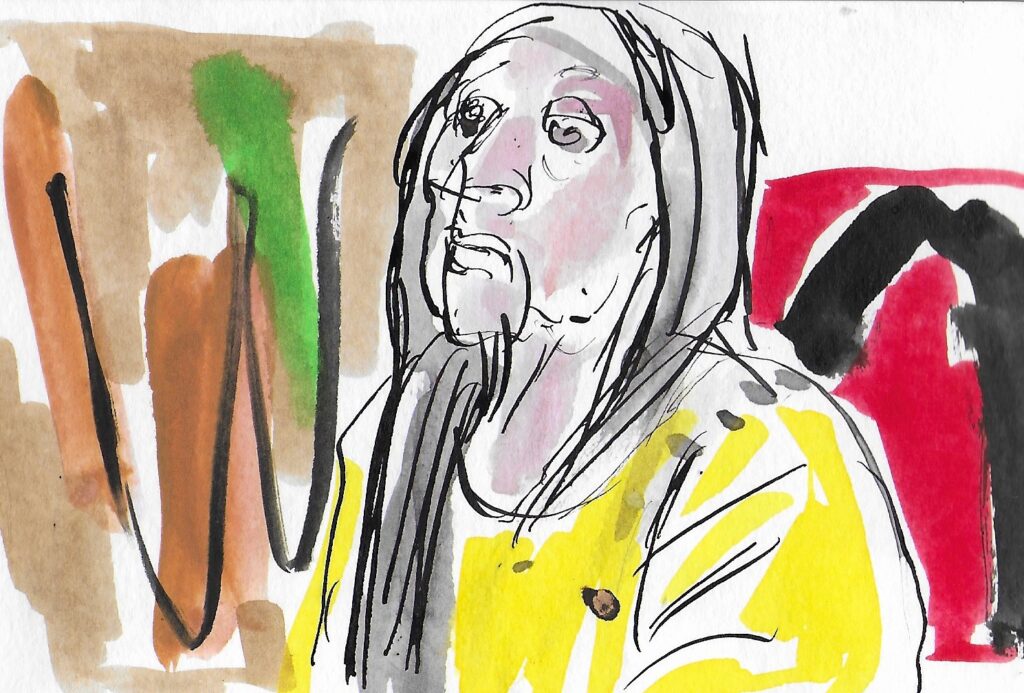
“I’ve been an artist all my life,” she said, “I weave, sculpt, paint….”. After she’d left a couple walked past. “Keep moving,” I heard the woman hiss to her husband, “or you’ll be drawn.”
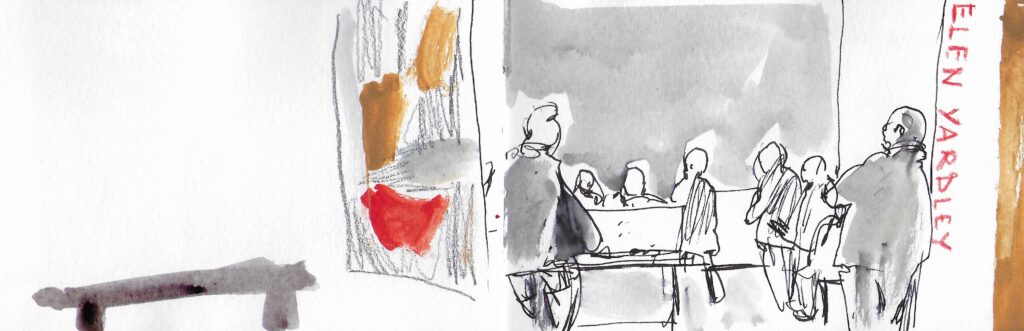
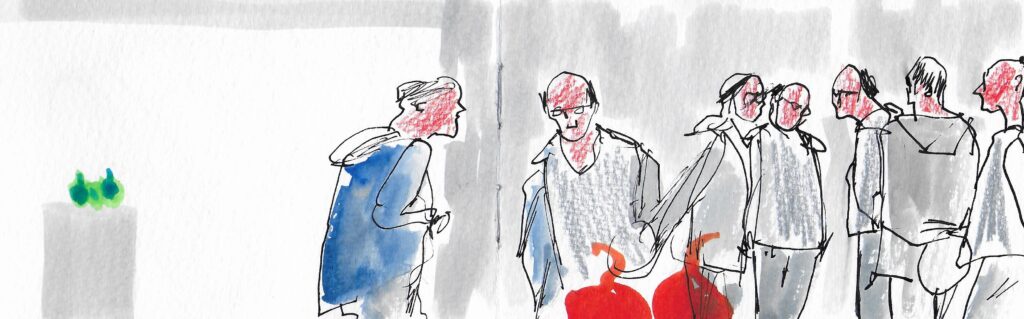
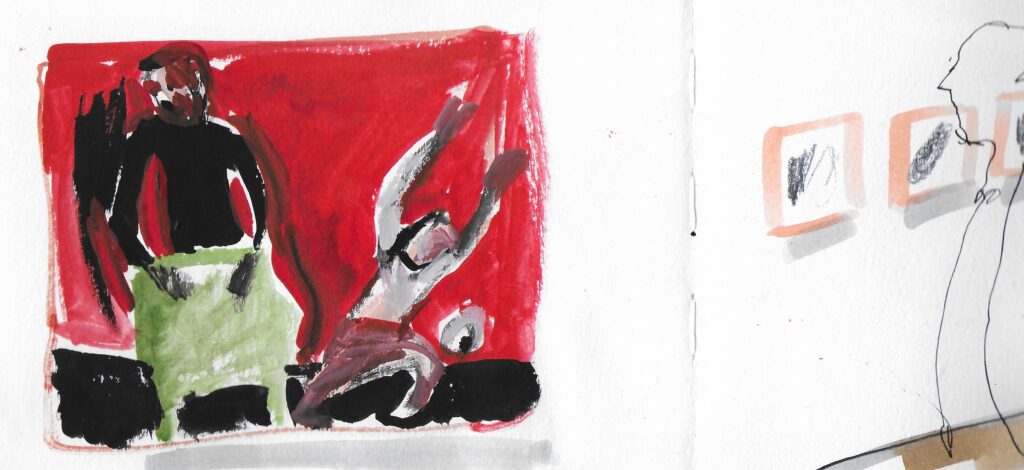
Just after midday a huddle of people came in making straight for Gallery 2 to watch Helen Yardley’s video en masse after which, they were all sent, armed with drawing boards and pastels, to find a ‘rug’ to draw. What a gift. (One of the gallery staff told me later that they were a group of people with dementia and their carers who come to RCC once a week for an art session.)
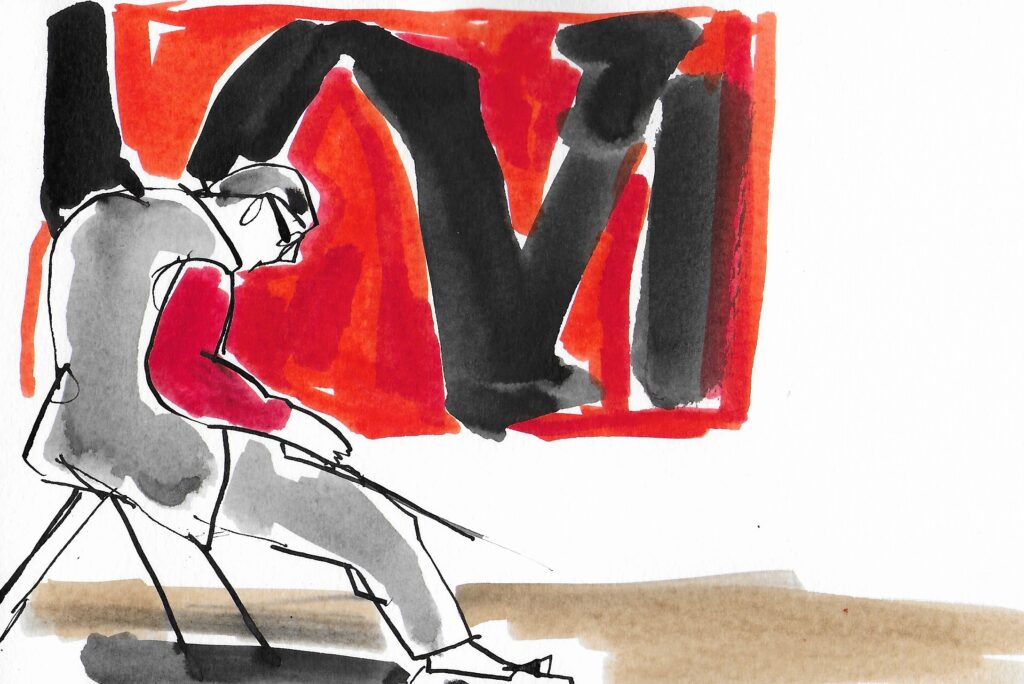
It was wonderful to draw them as they drew – they were so absorbed. At one point one of them stood up holding her arms up in the air. “Has anyone got any wipes,” she said, “I don’t like getting my hands dirty.” (I felt like openly commiserating with her. Since doing my daily drawing practice my fingers have developed permanent ink stains.)
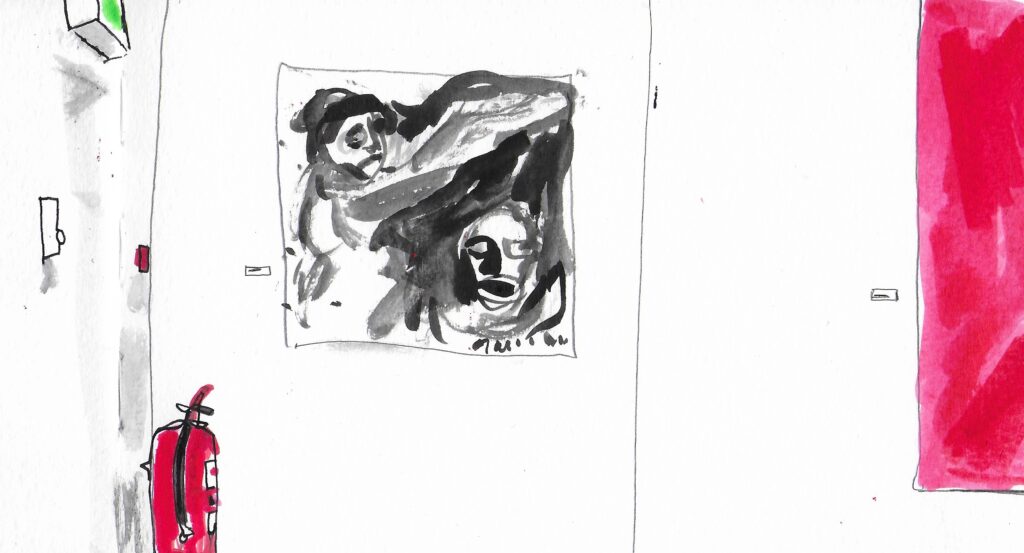
The slowness of footfall in both spaces meant that I spent more time not only engaging with the artworks myself but noticing, and indeed sensing, the gallery spaces themselves. In RCC I could hear the soft, comforting hum of voices from the shop and reception while in OD it was the clatter of crockery and the pungent smell of garlic from the newly opened café.
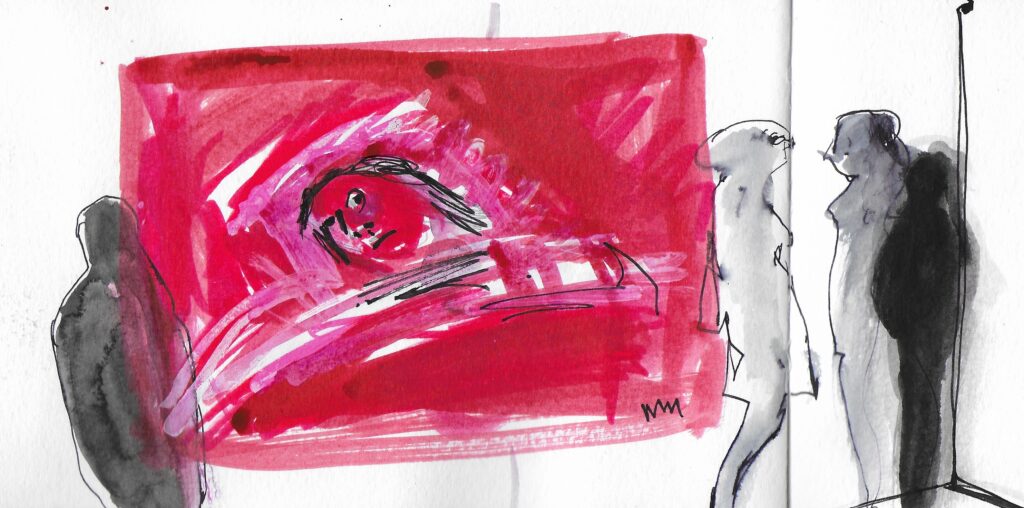
Wanting to sit among a different set of paintings and drawings, I worked in OD’s back gallery this time. It was an intense experience; even with my back to some of them I felt their presence behind me.

Most visitors didn’t stay long, some even racing through (perhaps it wasn’t what they expected). Most smiled, or at least acknowledged me. One woman stopped to talk.
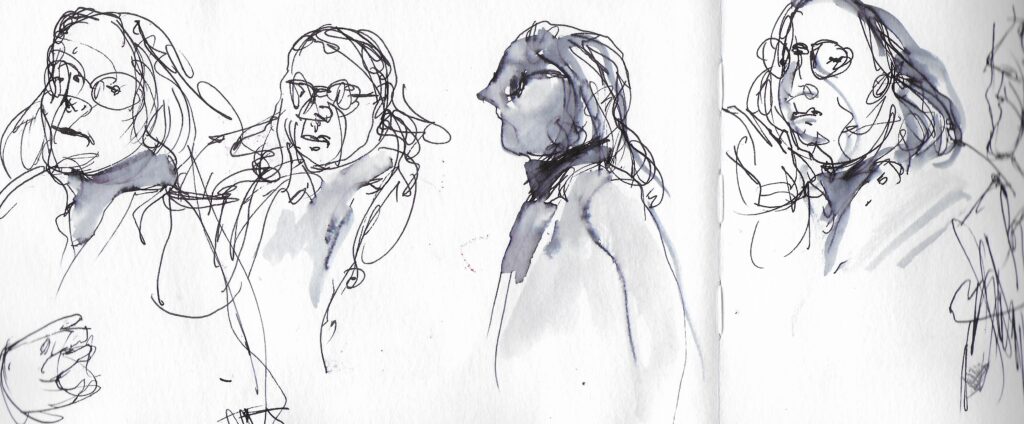
She’d recently retired (from working for an architect, I think she said, was it her husband?) and was taking up art again. She’d been attending various classes and had joined a non-tutored group but was dissatisfied with it. “All they do is chat,” she said.
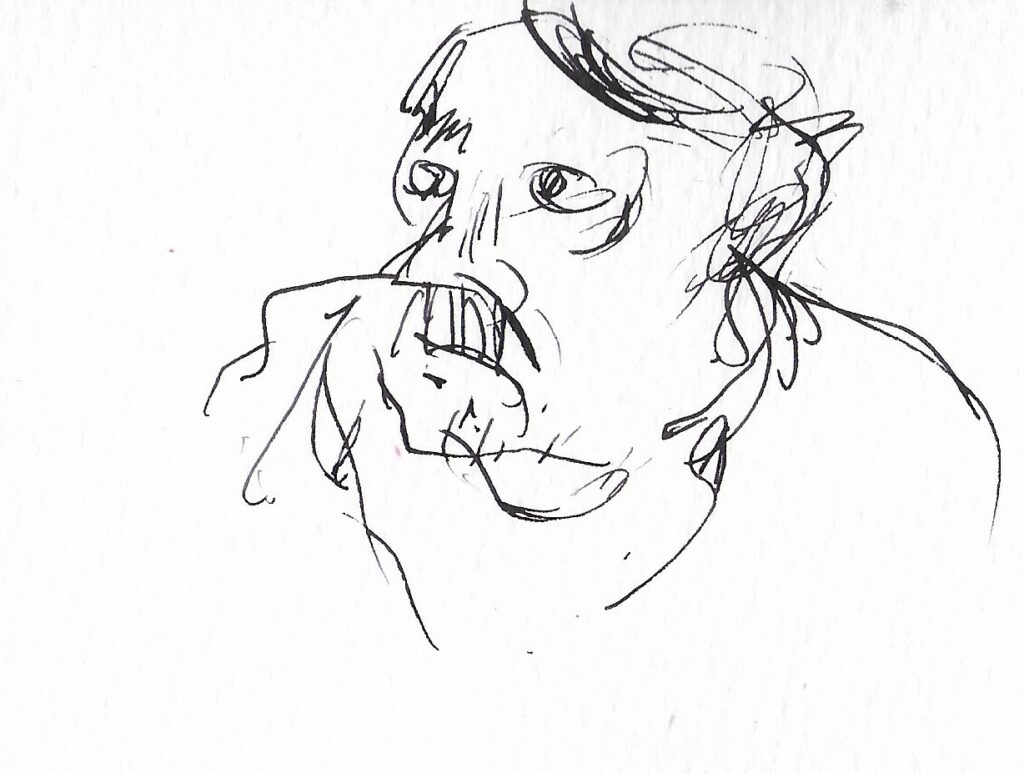
I’ve noticed how much bolder I become once I’ve been drawing in the galleries for an hour or so, even going so far as to make a drawing of RCC’s director as he spoke to me.
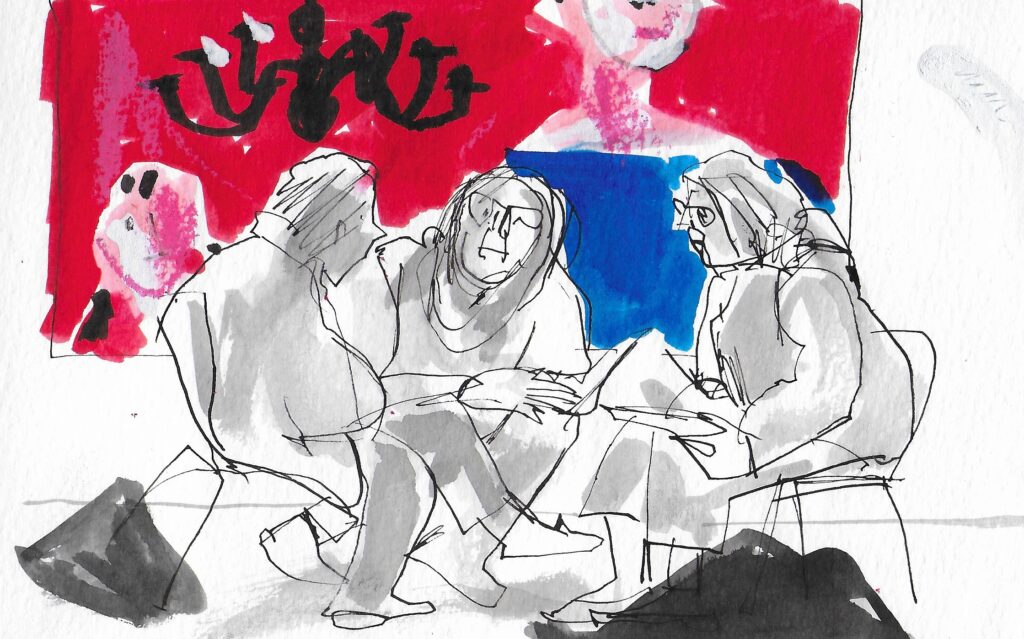
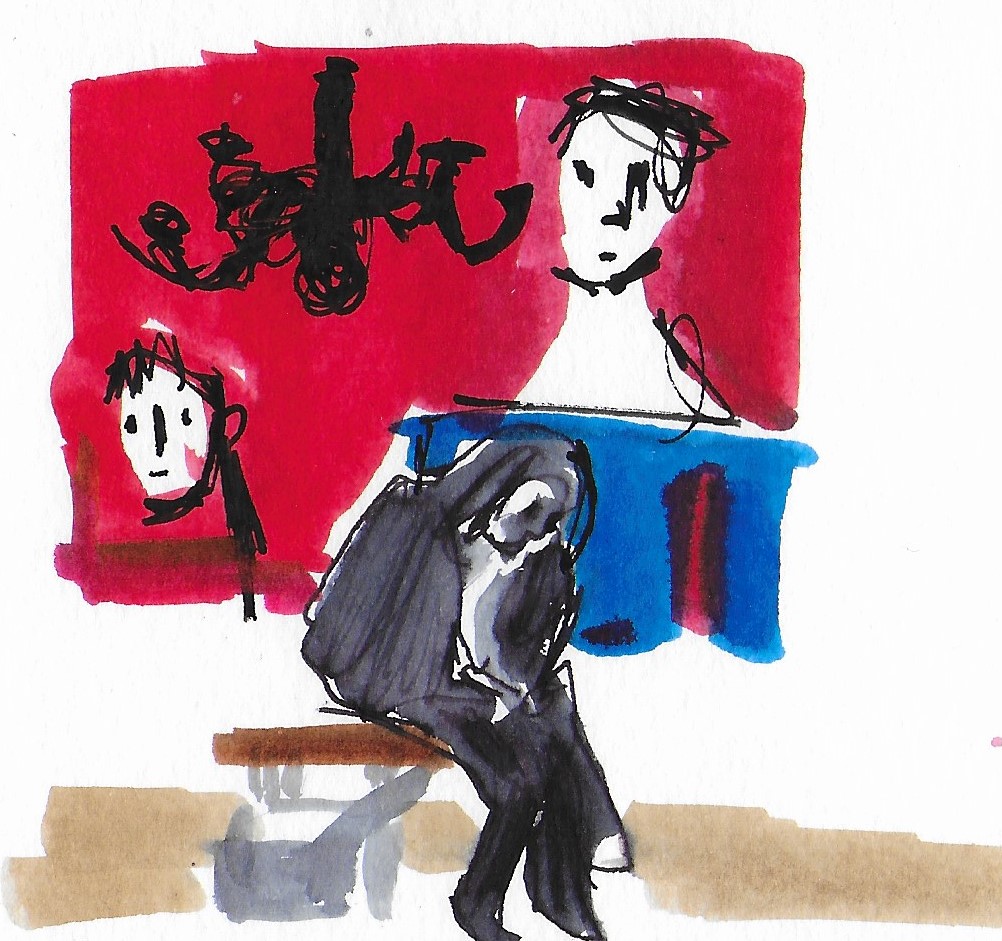
From my position in OD’s back gallery I saw three women arrive and seat themselves (with the help of chairs brought in from the Education Room) smack bang in front of Rhys James’ painting with the candelabra. I moved in closer. “We’ve got an artist working in there today,” I heard the Education Officer say.
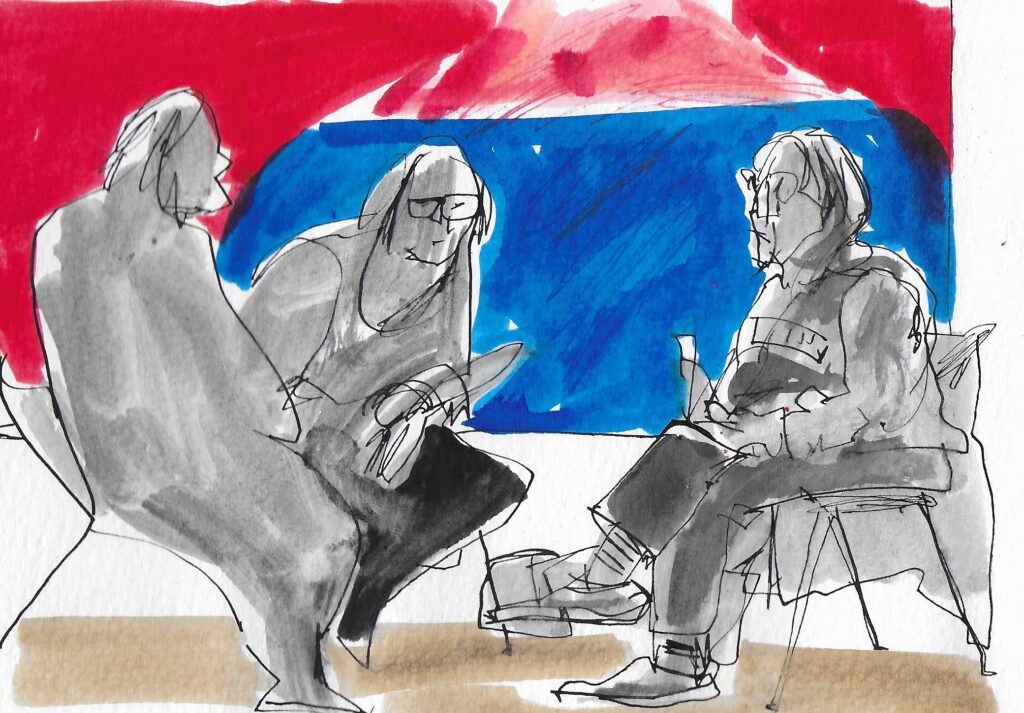
They spoke in Welsh and appeared to be discussing the Eisteddfod (with my poor grasp of the language, I could be completely wrong).
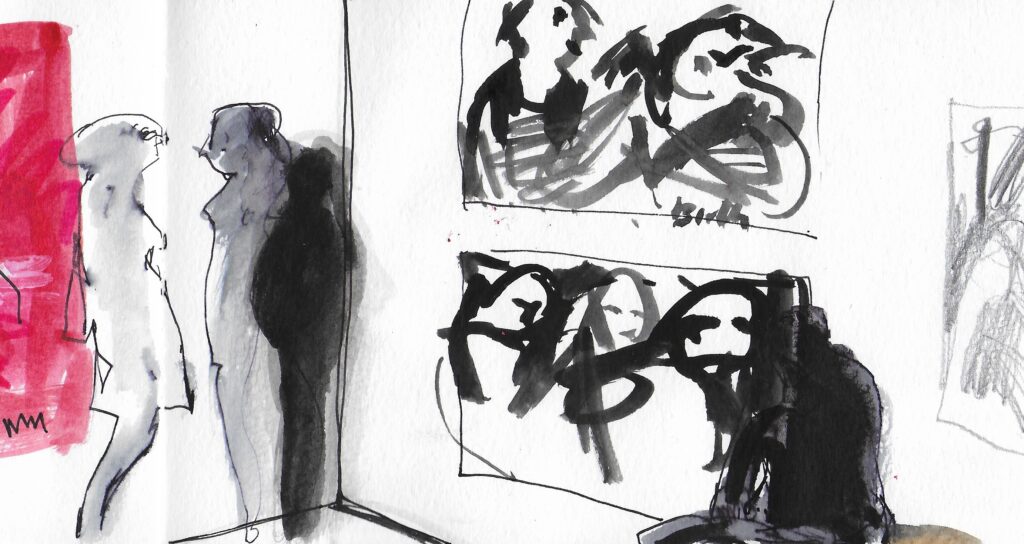
It was not only the power of the artworks but the speed in which people engaged with the works in OD’s back gallery that forced me to capture them as blurs, as shadows, and in some cases – particularly with the drawings – they almost became physically absorbed or even lost.
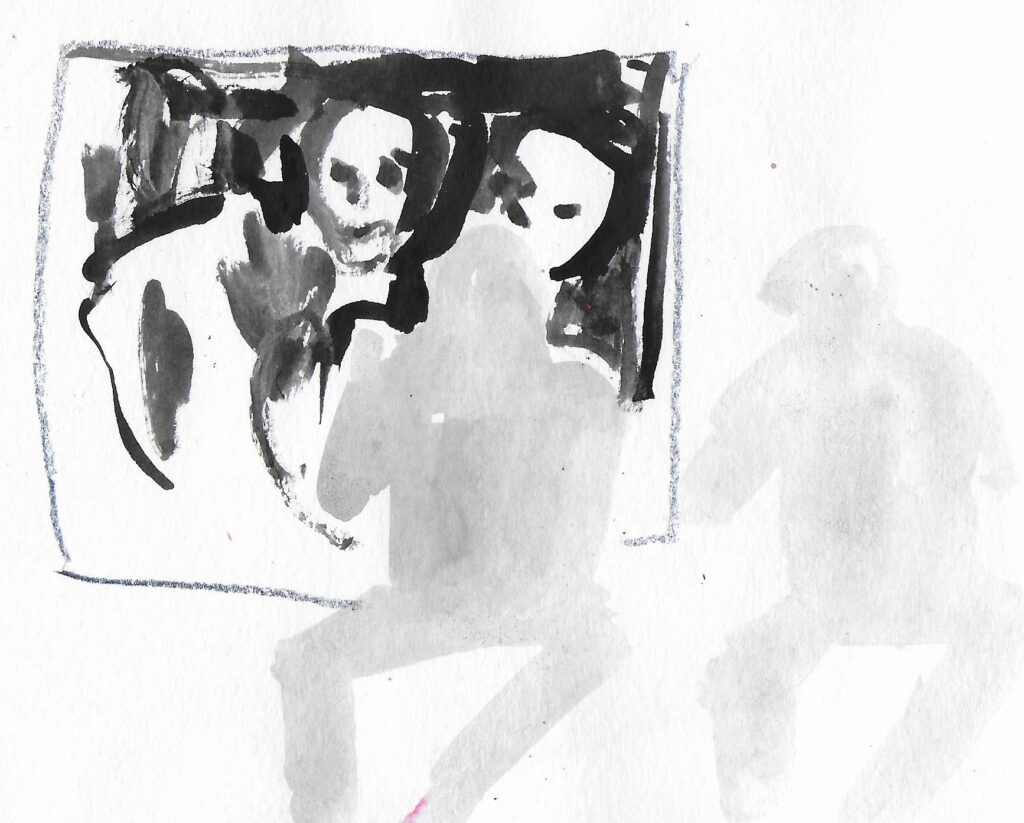
That’s the wonder (and the challenge) of responsive drawing; you have to go beyond the regular, the tried and tested, you are forced to. And sometimes it works, sometimes it doesn’t.
One of OD’s gallery staff suggested I pop into the Education Room to see the drawings a group of children had made of the exhibition (I think she said that they were seven years old). Most had responded to the ‘candelabra’ painting. “They saw it like a spider,” she said. The drawings were marvellous. So unselfconscious.
I think the thing that has most surprised me after these two months is how exhausting reportage drawing is. Every part of me has to be alert, awake and fired-up. It’s a tough state to maintain beyond 2-3 hours.
Nevertheless, I left both galleries exhilarated and eager to see what the next visits will bring my practice.
Categories
Gallery Watching

Gallery Watching – The Beginning

Drawing at Oriel Davies on Wednesday 21 September 2022 in front of a work by Stephen West (Photo: Pip Jones)

After over a year of ‘practising’, my Arts Council Wales funded reportage drawing project Gwylio’r Gwylwr/Gallery Watching began in earnest last month with consecutive visits to my host galleries – Ruthin Craft Centre and Oriel Davies, Newtown.

The project sprang from a desire to pare down my art practice and find a more authentic, spontaneous and reactive way of working. A writer and reviewer in my other life, galleries and the human behaviour they excite, have always fascinated me. As a result, I have frequently used such spaces as sites for my installation and performance work. Harking back to an Illustration degree that I took in the 1990s, I have always been intrigued by reportage drawing (Gary Embury and Mario Minichiello in their superlative book Reportage Illustration, define it as: ‘capturing the dynamics of unfolding events…..sketching the appearance of a scene as well as striving to understand and communicate a story through visual language‘). I adore its immediacy and that kind of make-or-break experience of drawing.

Though in awe of reportage artists both living and dead (such as Ronald Searle, Mervyn Peake, George Butler, Audrey Hawkins and Veronica Lawlor) who choose to cover difficult and often harrowing political events, my oeuvre is a more benign one. I just love to watch people – and what better place to do that than in art gallery?

Nevertheless, however I do it, drawing, or at least the public performance of drawing, still petrifies me. (It was somewhat consoling to read that the great Paul Hogarth also used to get nervous before beginning a reportage commission.)

Ruthin (RCC) was my first port of call. A somewhat intimidating space at the best of times – with its wide open-ness, bright light and with no real hidden nooks or crannies in which to secrete myself – I felt like I was on stage, exposed and nervously awaiting my audience.

A couple from Sunderland, clearly entranced by Neil Wilkin & Rachael Woodman’s glass show, were my first ‘models’ (or should I say ‘victims’?). They asked what I was doing and we had a long conversation about glass (when I should’ve been drawing). Next there was a woman from Holland. “I’m an illustrator,” she said, adding, “If you draw me I’ll buy it.” (I did draw her while she was leaning at a perfect right-angle looking at a Jenni Moncur carpet, but didn’t show it to her.)

It was the day after the Queen’s funeral, so it wasn’t surprising that it was pretty quiet, but at least the flow of visitors was constant. (From the experience of ‘practising’ in coffee shops, where I draw the queue, I find I need this flow in order to maintain an energy of both hand and mind. And so that I don’t have time to think too much (!).

Nerves made my penmanship (and decision-making) slow and stiff. I hadn’t really noticed how fast some people move around gallery spaces, particularly men for some reason. And in RCC there’s that distance to deal with, but needing to sit and have all my drawing paraphernalia around me makes me static (when I long to get up and walk around). How do those professional reportage artists manage, I found myself thinking more than once? Harry Morgan straps a drawing board round his neck and walks as he draws, but most, like me, choose to sit. Planning and refining the drawing materials you intend to use beforehand seems to be the answer – though I’ve yet to get this off to a fine art, particularly when the galleries (and a lot of their visitors) exude such colour.

Later, I watched an elderly lady pushing a walker circumnavigating the galleries at an extreme speed, so much so that I thought she would collide with me. “So they still teach drawing in art schools, do they?” she said, brusquely. I tried to explain that I wasn’t a student and hadn’t been for some years but she’d moved on.

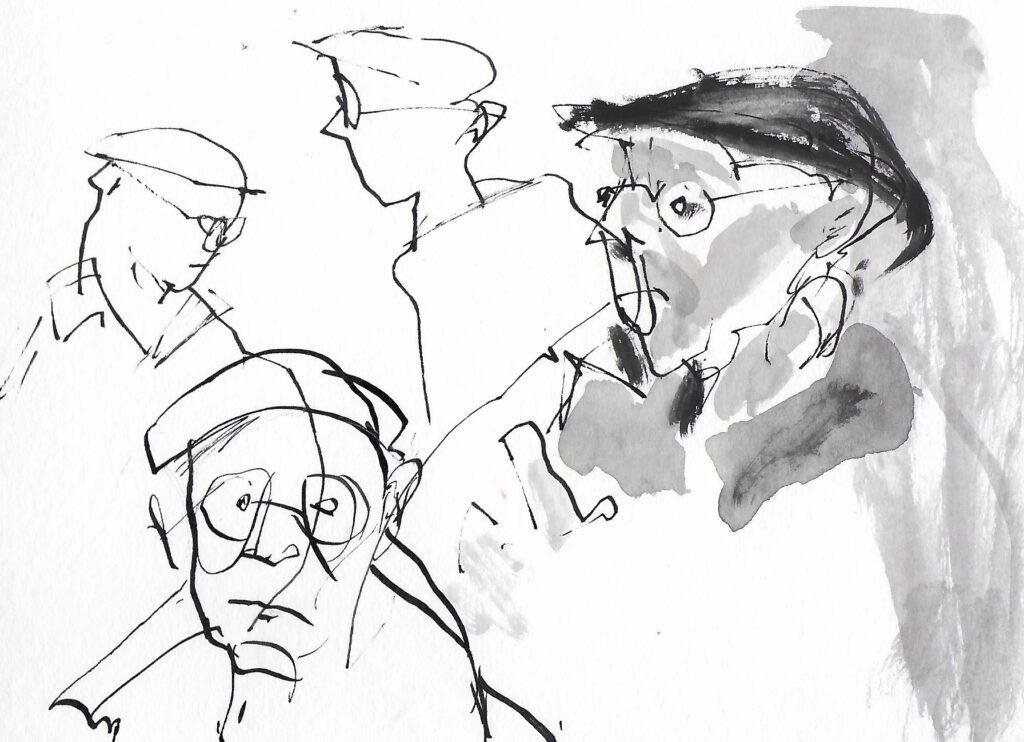
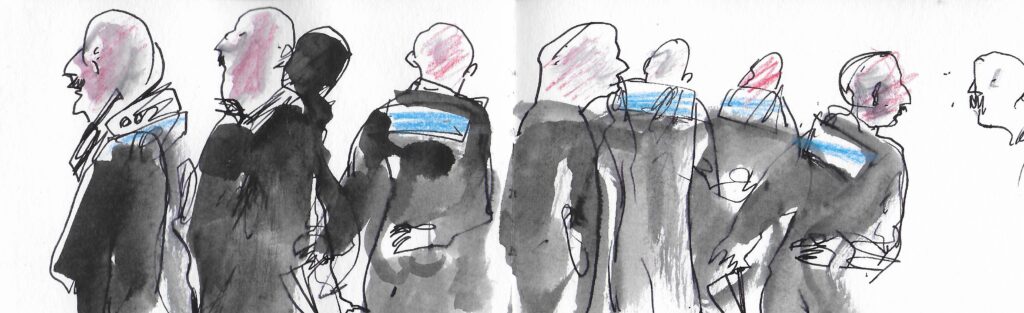
But for all my initial frustration with my line (being at the mercy of recalcitrant dip pens) and slow mental responsiveness, there were some real ‘gifts’ – such as the arrival of a group of women – all wearing black – who toured around the gallery spaces several times and provided me with some real energetic drawings. Thank you RCC – in the end it was a real joy.

The next day I went to Oriel Davies (OD).

OD is a very different space to conjure with; it’s smaller and by nature a little more intimate but I am still on show and in some ways more so. And the visitors can’t hide from me either.

The morning was quiet and I spent some time looking at and drawing Shani Rhys James’ and Stephen West’s paintings and drawings, prompting one man (I’d watched him visit each work and study them carefully) to ask: “Why are you painting the paintings?”

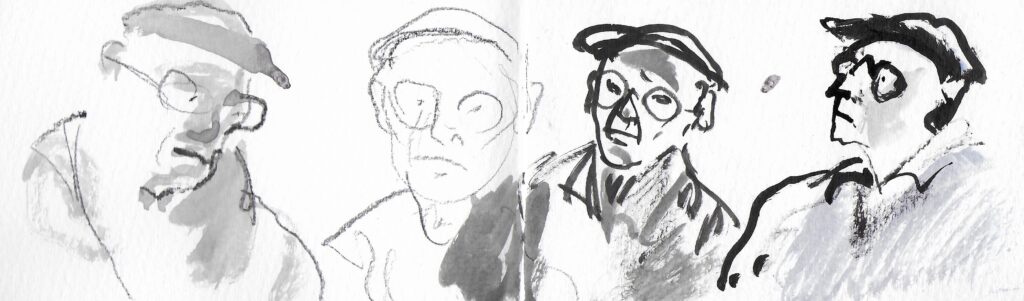
And what a treasure he turned out to be. An ex-lecturer and an artist himself we entered into a fascinating conversation about art (“I call myself an artisan”), the pros and cons of dip pens (“You should use a fountain pen”) and the closure of city centre galleries. And best of all he let me draw him as he talked.

It was exhilarating.

People seemed more willing, or perhaps more comfortable, engaging with me in OD. I’m not sure why. Some asked me if I was Shani Rhys James herself. Others were just curious about what I was doing.

The range of visitors was fascinating. A couple joined another woman who’d been talking to me, telling her (and me) that they just come from teaching Welsh poetry via a harp at a primary school nearby. And then two police officers came in, in full uniform. The man was particularly fastidious, stopping in front of each and every art work to look and ingest. His female companion did rather a lot of giggling (whether at him or the art it was hard to say). Later a young woman leading an elderly man by the arm came in. “Let’s just choose which one you like best, ” she said. He didn’t raise his head once.

I relish the different experiences the galleries offer me – both by the nature of the spaces and the demographic of visitors. And sometimes just being there – given permission to just sit and observe (amid all that glorious colour) – was enough. So thank you OD, I had a marvellous day.