
Oh, why am I still a bag of nerves when I turn up to the galleries to draw? A little adrenalin is a good thing, but this anxiety that hollows out my stomach and makes me scratchy and edgy, is not. I try to contain it and be as well-mannered as I can, but those first ten, fifteen minutes or so between arriving, finding a place to sit and starting to draw are excruciating. Merely scanning the other two galleries, I knew, almost from the start, that I wanted to sit among RCC’s Animal Rites exhibition in Gallery 3. And what a joy it was!

At the start of this project I used to fret if there were no visitors. I am more sanguine now (see what I’ve learnt!) and, if nothing else is going on, I draw the art and the spaces and wait. Someone always comes. Liz Ellis’s crows and magpies – rendered gorgeously sinister by their blue-black brittle ceramic plumage – balanced on perches and metal hoops appear to climb the wall. I drew them over and over, too close to do them justice. But using ink, heavy graphite and thick pencil was, nevertheless, a good loosening-up process.

In direct contrast, Zoe Whiteside’s softness of polar bears called for white spaces and simple, contained lines. I could feel myself warming, relaxing and even enjoying myself. Hurrah.

But I was still not quite getting the crows. I needed to be further away and work larger but I want to contain the drawings in the sketchbooks – perhaps next time I could attach a kind of concertina page? I love the paraphernalia of the gallery spaces, such as the sockets, juxtaposed against the expressive freedom of the animal forms. As I sat and drew I fantasised about taking some of these fantastic creatures home.

Though it was quiet, visitors did come and go. Perhaps it was the late April sun outside. I could see people through the window sitting on the benches having coffee. It’s such a gentle place. Why was I so scared?

Ah, how I adore Brendan Hesmonhalgh’s bulls. I have a vague memory of seeing him demonstrating at the 2019 ICF in Aberystwyth. I couldn’t do justice to the painterly-ness of them, those touches of blue, of pink and the way the head of the larger one leans to one side, with a not-to-be-believed promise of benignity.

More crows in smudgey black.

People lean in, hands dug firmly into their pockets, as if controlling the desire to touch. I didn’t have many conversations today. I felt a little guilty. I was too absorbed, having too much fun. The few that I had included a woman who told me of her drawing practice and then asked if she could look at my books. Having done so and she then asked whether there was to be an exhibition. Another woman glanced down at a couple of books that I’d left on the floor. “Are they in your way?” I asked. She shook her head and muttered the word, “impressive” under her breath. Later a man on his way through to Gallery 2 stopped to look at what I was doing. “Is that a pencil that you’re using?” he asked. Yes, I said. “It’s a very thin line,” he said.

A visual amalgam of wheeled Victorian toys, archaic drawings of imagined animals and illustrations from Aesop’s Fables, Louise Bell’s collection of creatures delighted me. I want each and everyone of them and drew them with real pleasure.

Responding to the lack of constraint required in capturing these whimsical beings, I jumped up from my seat and stood or sat on the edge of the low plinth (sorry RCC) with my grabbed collection of pencils, crayons and oil pastels scattered on the floor.
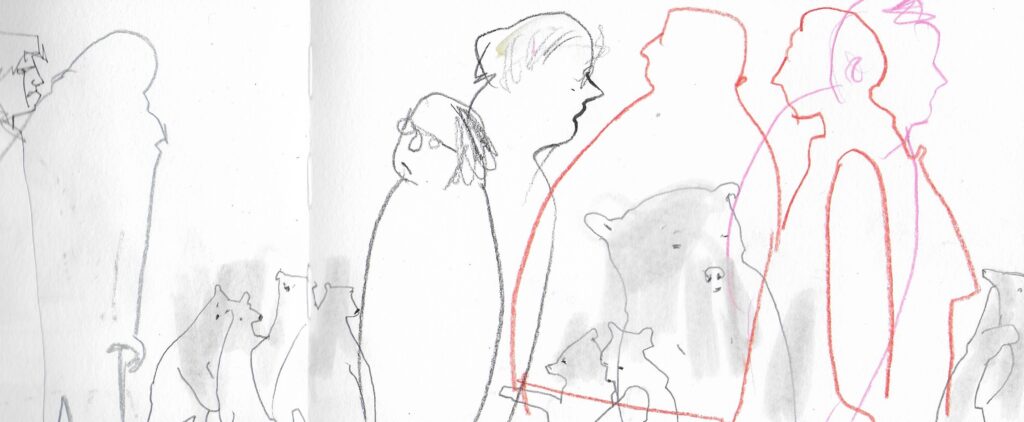
Keeping several drawings going at once, I added a layering of human bodies over or behind Whiteside’s ‘lovingness’ of bears.

Freed-up by an energy borne out of using such an array of materials and the unpreciousness of my mark-making, I stopped trying to be so literal in describing the gallery space, allowing Whiteside’s penguins and Hesmondhalgh’s bulls and Jack Durling’s rhino to float around, encircling and challenging their lookers-on from all sides.

Spent, and packing up to leave, the ‘Lost in Art‘ group started amassing at the other end of the the gallery. As the huddle of people approached me, a one-legged man in a wheelchair looked at one of the ceramic animals and then looked at me, “That’s not you, is it?” he asked. I made a quick drawing of him but by then my self-consciousness had returned, and the marks were tentative. Made wary and hamstrung over the issue of consent and feeling that I might be somehow stealing something from him, I was hobbled. Sensitivity had punctured me – it was time to go home. Oh, but what a day.

If I was anxious about drawing in RCC, I was doubly so about my day at Oriel Davies. With the Gallery closed to exhibitions, I’d suggested that I might come and draw at their Spring Fayre. As with all these things, it had seemed like a good idea at the time – lots of colour, tents, people milling around – I might even do some larger scale drawings, I thought.

For weeks beforehand they’d been promising rain. And that, mixed with my collywobbles about having to make drawings in a less contained and familiar space and without the focus of a particular artwork or show, combined to throw me completely. I got there way too early. A slow steady drizzly rain was falling as the stallholders began raising marquees, fixing tents and spreading their ware on tables. It was cold and damp.

So I went into the gallery cafe, hogged the sofa and drew.

A smattering of people occupied some of the tables. One woman looked like she was either knitting or sewing.
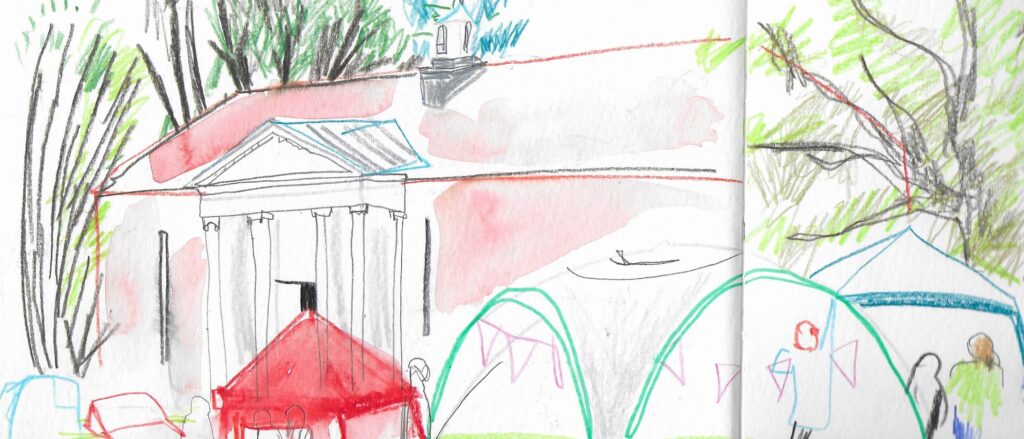
But I knew it wouldn’t do. I had to go out and face my fears. Besides, they’d put some tables under the awning, so at least I could sit and spread some materials out in front of me. How do reportage artists in war zones, or those covering demonstrations and marches do it? I’d come without my usual tool box of stuff, but I still had packs of crayons, a pouch of pencils, some pens and water brushes.
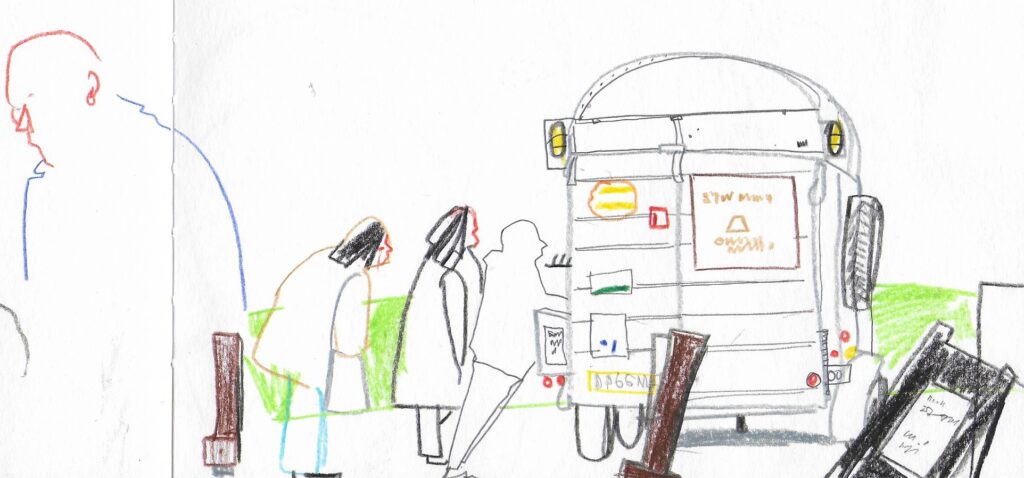
I don’t draw well when I’m fearful. I freeze up. And I watch every line, judging it and shouting it down. There was so much going on. Tent after tent, a hotch-potch of soggy canvas in mismatching colour, all set against the formal, pseudo-Italianate grandeur of Newtown’s Town Hall. To the right of me was a metal truck selling coffees, and, rather surprisingly, sausage rolls. I watched and drew the rather desultory queue that began to form outside it.
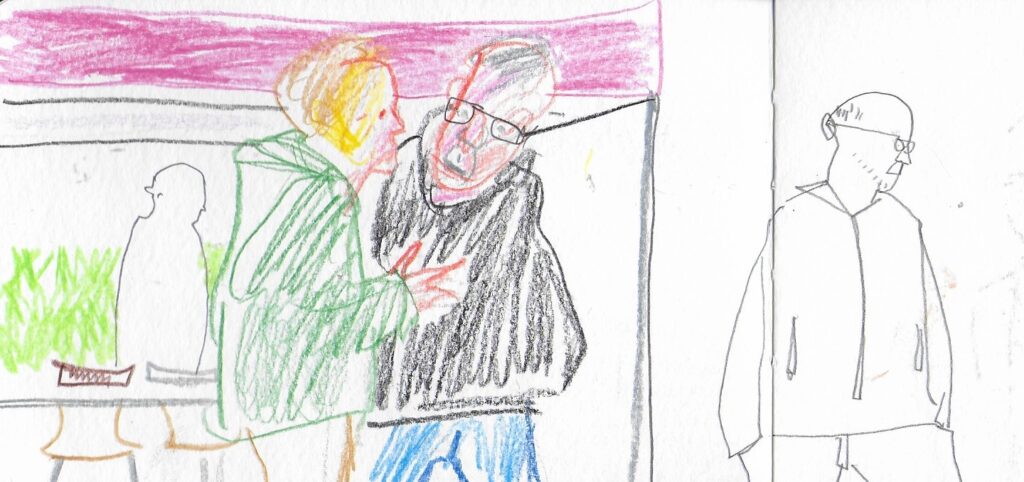
To the left of where I was sitting was the ‘Seed Tent’, from which I could hear a very ebullient woman talking to several people about what sounded like ‘rainbow-coloured soup’. A man hovered nearby, seemingly accosting people for a survey he appeared to be conducting.
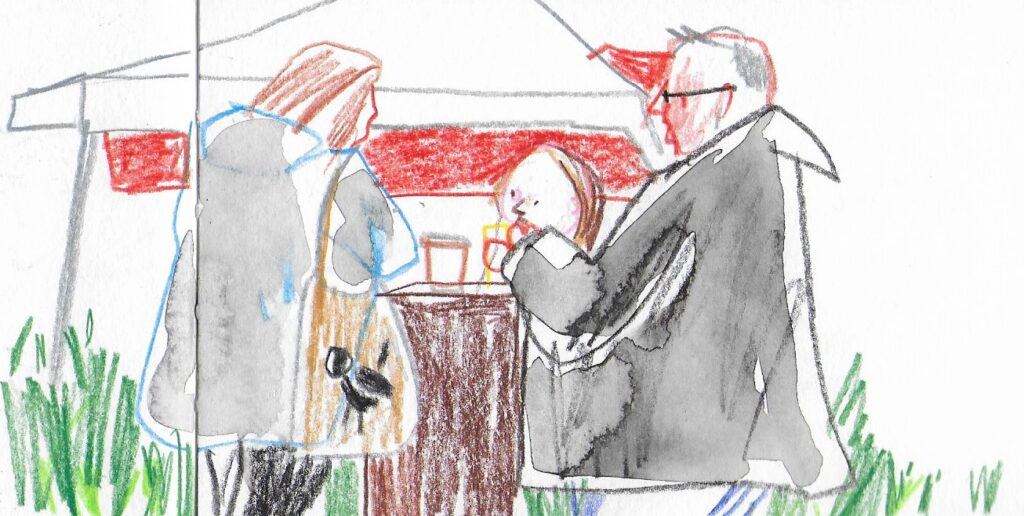
Families began arriving, coffees and cakes were brought out from the cafe and eaten ad hoc off the metal bollard-like structures outside the gallery.
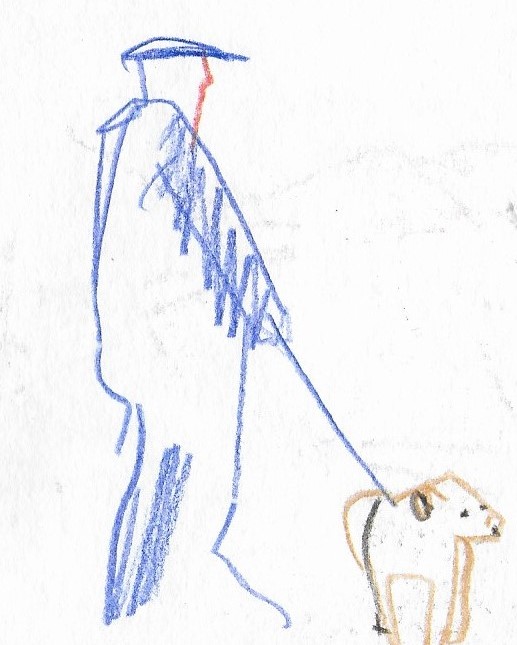
I was overwhelmed. The drumming had started up by then and what with the chattering from the seed stall and the man doing his surveys and the other snatches of music that seemed to pulse from every tent, concentrating on the task in hand was a monumental one. Focus on the detail, I kept telling myself. Zoom in on human stories. Tell your story. I tried, such as with the man out walking his dog who was clearly rather bemused by it all. As indeed was the dog.

I smelt them first. A kind of warm-wet-straw-on-the-floor-of-a-cowshed sort of stink. Two llamas, one of which appeared to be called Cedric. Still egdy with nerves and self-consciousness, I scribbled out a response before they were led off.

On a table behind me a woman, evidently a carer, had seated a man before getting up to greet the woman who I’d drawn in the coffee van queue. Bringing the man a drink from the cafe – what she referred to as his usual “chocolate-coffee” – she bemoaned the fact that there was no sugar. The man said nothing. After settling the woman at the table, the carer bounded up, saying she’d go and bring the car nearer. I watched as the remaining woman stood up and, her handbag held closely to her chest, ambled towards the seed tent only to be intercepted by the survey man.
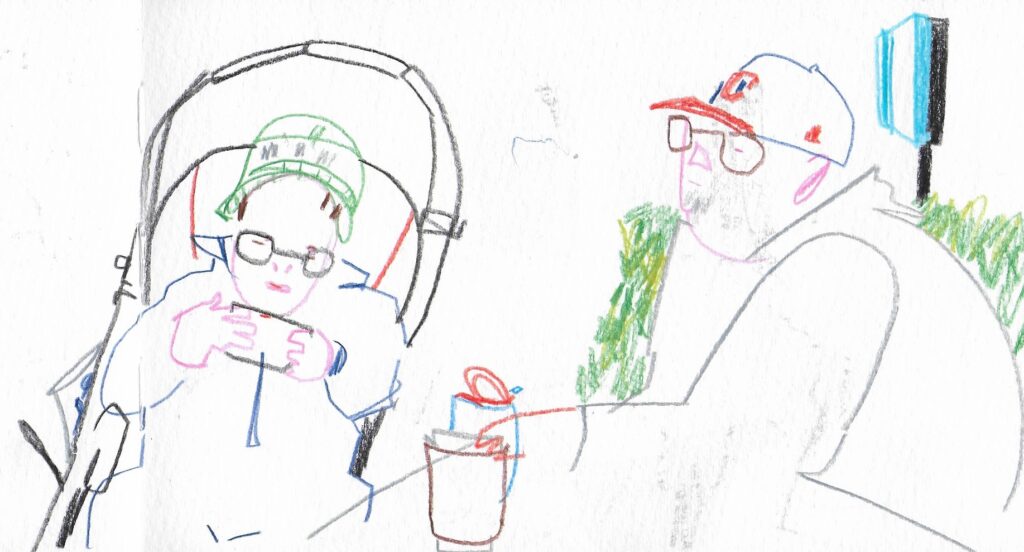
Meanwhile, on the table opposite me, a father sat with his son while his wife went off to do some shopping. Utterly absorbed by some game or other he was playing on a mini device, the little boy made no response to his father’s occasional questions or urgings to drink. I watched him intently. Every now and then his face would break out into a smile and sometimes he’d let out a giggle.

Tired now, I returned to the relative safety and containment of the cafe. It was busy.

Mainly occupied by middle-aged couples, all the tables were taken.

Two men with almost identical grey beards came in. One sat down at a recently vacated table while the other stood in the queue. When he joined his companion he didn’t talk but began signing.

Having exhausted all that I’d had to give that day, I managed a quick drawing of a man in gold-sequinned top hat who’d just joined the queue. I’d had high hopes for my drawing that day. Perhaps I’d expected too much; certainly nerves had taken their toll on the confidence I needed to push myself to rise to the day’s challenges. Nevertheless I’m glad for the Gallery that the event had brought crowds and, despite the weather, had prompted a generosity of spirit and energy.